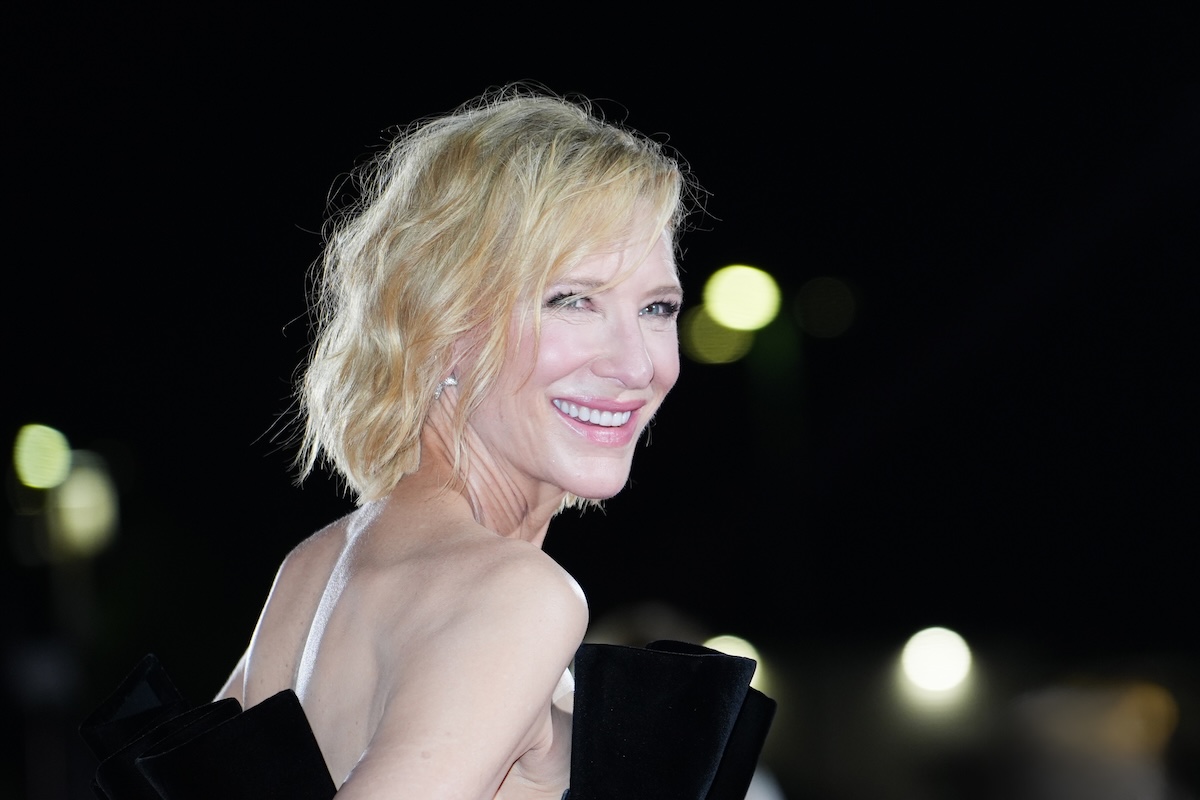
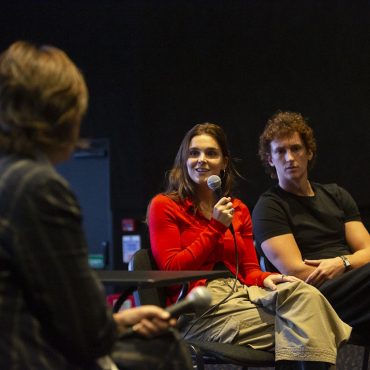
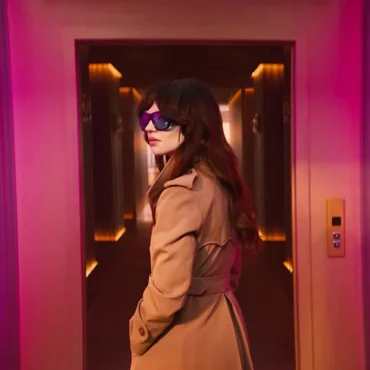
On Sunday, 17 May 2026, in the Salle Buñuel, the 79th Festival de Cannes hosted Cate Blanchett for one of its “Rendez-vous with…” conversations, a format conceived as an extension of the Official Selection through direct exchanges with major figures in contemporary cinema. The official programme framed the meeting around an actress, producer and cultural advocate whose history with Cannes includes Carol, Babel, The New Boy, Rumours and her presidency of the Competition Jury in 2018.
What followed was not a conventional career talk. Blanchett treated the room as a place to think aloud about the role of festivals, the ethics of representation, the instability of acting and the anxieties now surrounding artificial intelligence. Her first major idea was also the clearest: festivals matter because they still create a shared civic space for stories that might otherwise remain unseen. She described them as places of “discussion” and “dissemination”, adding that cinema often helps audiences work out how they feel about a world that is becoming “more and more absurd.”
The jury room is a school of listening.
Asked about her experience as President of the Cannes Jury in 2018, Cate Blanchett described the role less as a position of authority than as an exercise in attention. She recalled a deceptively simple piece of advice given to her by Guillermo del Toro: never sit in the same chair twice during deliberations. In a room where major decisions are made, even the place one occupies can shape who speaks first, who feels heard and how the conversation begins.
For Blanchett, that small practical gesture became a way of opening up the process. Changing seats shifted the discussion’s rhythm, allowing different voices to enter first and preventing the jury from falling into fixed patterns. Her task, she suggested, was not to impose an agenda, but to “bring alive the group mind”, so that the final decisions could be shared by the whole jury rather than directed by its president.
Her most cinephile observation concerned the need to meet each film on its own terms. She spoke about moments when a film does not fully reveal itself at first viewing, and how another jury member’s passionate defence could send her back into a morning screening to watch it again. “You’re not ready to receive a film,” she said of certain first encounters. The responsibility of a jury, for Blanchett, is not to confirm personal taste, but to understand intention, form and risk. “It’s not about taste, it’s about appreciation,” she said.
2018, equality and the unfinished work
The conversation inevitably returned to the 2018 Cannes staircase protest, when Cate Blanchett, Agnès Varda and women filmmakers gathered in support of gender equality in the industry. Looking back, Blanchett refused to treat the moment as symbolic closure. The issue, she argued, remains structural. “If you don’t identify a problem, you can’t solve the problem,” she said, underlining how quickly uncomfortable conversations are shut down once they expose systemic abuse or imbalance.
She described arriving on sets and still mentally counting the gender divide. “There are 10 women, and there are 75 men every morning,” she noted, before adding with irony, “And I love men.” The point was not antagonism, but repetition. In a homogenous workplace, she said, “the jokes become the same,” and that sameness affects not only the atmosphere, but the work itself.
Her formulation was sharp and useful: when voices are repeatedly similar, cinema becomes “a bit beige for an audience.” For Blanchett, equality is not fashion, branding or seasonal language. “Why should equality be a fashionable thing?” she asked later in the conversation, rejecting the idea that representation can move in and out of cultural style. It is a question of access, mentorship, production power and distribution money.
She also linked inclusion to sustainability, arguing that films about climate change mean little if the work itself is not made with environmental responsibility. “If we’re not making the work in a way that is sustainable, then that’s a deep hypocrisy,” she said. For Blanchett, the question is therefore broader than gender alone. It concerns how films are made, who gets to make them, which stories reach audiences and whether the industry is willing to change its own habits rather than simply speak about change.
Acting as quicksand, not certainty
The most generous passage on craft came when Blanchett described acting as a practice that begins with ignorance. She spoke of leaving drama school with technique, then slowly understanding that artistic work happens on unstable ground. “I work better in quicksand,” she said, because each project reveals its own demands.
Preparation, in her view, must disappear before performance. Discussing I’m Not There, she remembered arriving on Todd Haynes’ set after an almost impossible schedule, having watched material on Bob Dylan while filming Elizabeth: The Golden Age. Yet the work only became useful once the costume, eyebrows and atmosphere of the set were in place. “No one wants to see your homework as an actor,” Blanchett said, offering one of the afternoon’s most memorable lessons.
She also revisited Babel and Alejandro González Iñárritu, describing an intense set where tough direction could knock an actor off balance. The memory led to one of the meeting’s more nuanced points: cinema needs spaces that are both respectful and rigorous. Her ideal was not softness. It was rigour with joy.
The lasting mystery of Carol
For cinephiles, one of the most revealing passages came when Blanchett returned to Todd Haynes and Carol. Asked about the final scene and whether the character had an inner monologue in that last look, she refused to close the moment’s meaning. Her answer was technical, precise and deeply aligned with the film’s emotional power.
Because of the nature of the shot, Blanchett explained, she and Rooney Mara could not actually look at each other. They were instead looking at “projections and memories of each other.” That detail makes the scene even more fragile: what appears as direct recognition is, in fact, a performance built on distance, timing and remembered intimacy.
For Blanchett, the power of the ending lies in its openness. She said it was important not to lock the scene down so the audience could leave wondering what the characters were thinking and what might happen next. “Ambiguity is one of the hardest things I think to create on screen,” she said. In that sense, the final look of Carol remains one of the purest examples of what she defended throughout the conversation: cinema as a place where meaning continues after the image has disappeared.
TÁR, power and the brutality of creation
The question of ambiguity is also connected to TÁR. Speaking about Todd Field’s film, Blanchett resisted the simplest interpretation. She did not see it only as a story about cancel culture. For her, it was “a meditation on power.”
The name Lydia Tár, she noted, can also be read as an anagram of “art”, a clue that allowed her to think about the brutality of the creative process itself. Her interpretation was not defensive, but complex. Lydia Tár, she suggested, is brutal toward herself before that violence is externalised. Creation and destruction, in her view, are not always separate forces. They can feed each other, disturb each other and become dangerously intertwined.
That reading gave the discussion a wider resonance. TÁR became less a verdict on one character than an inquiry into power, discipline, ego, talent and collapse. It also prepared the ground for one of the final questions of the Rendez-vous: whether audiences can, or should, separate the artist from the art.
Can we separate the artist from the art?
In the final part of the conversation, Blanchett was asked one of the most difficult questions for contemporary cinephilia: whether it is still possible, or even legitimate, to separate the artist from the work. Her answer did not look for an easy moral formula. Instead, she brought the question back to the complexity of cinema itself, an art form made by many hands, not by one author alone.
For Blanchett, the issue is not about cancelling complexity or protecting artists from scrutiny. It is about resisting simplistic readings. A film, she suggested throughout the conversation, is never only the expression of one personality. It is a collective object, shaped by actors, directors, writers, cinematographers, editors, production designers, crews and audiences. That is why the ethical debate around an artist cannot be reduced to a single, comfortable answer.
The question also returned to her reflections on TÁR. If Todd Field’s film is, as she said, “a meditation on power”, then its value lies precisely in its capacity to keep spectators in an uncomfortable space. Art, for Blanchett, does not exist to tell audiences what to think. “I never want to tell an audience what to think,” she said earlier in the conversation. Its role is to provoke questions that continue after the screening.
This made the exchange feel less like a conclusion than a challenge. In an industry increasingly shaped by public judgment, political pressure and accelerated opinion, Blanchett defended cinema as a place where contradiction can still be examined. The artist and the art may never be entirely separable, but neither should the work be flattened into biography, scandal or verdict. What matters is whether the film remains capable of opening a conversation that is larger, more difficult and more alive than the certainty with which audiences entered the room.
Cinema as a collective experience
What made the Cannes Rendez-vous memorable was how consistently Blanchett brought cinema back to shared experience. She spoke about acting, juries, equality, authorship and AI. Still, the underlying question remained the same: how can cinema remain a space of human encounter in a culture increasingly shaped by speed, simplification and technological opacity?
Her answer was never nostalgic. She did not reject change, but she insisted on responsibility. She did not romanticise the past, but she defended the conditions that allow art to remain complex. Festivals, in her view, are not only showcases. They are rooms where difficult questions can be made public. Film sets are not only workplaces. They are structures that shape what audiences eventually see. Performances are not only technical achievements. They are acts of listening, uncertainty and trust.
By the end, Blanchett had offered more than a career reflection. She had mapped a philosophy of cinema built around attention: attention to who speaks, who is represented, who is heard, who gives consent and who remains visible behind the image. In that sense, her strongest line on AI also became the key to the whole afternoon. “Human consent has to be placed front and centre.” For Cate Blanchett, the future of cinema depends on whether the industry can still recognise, protect and value the human hand.