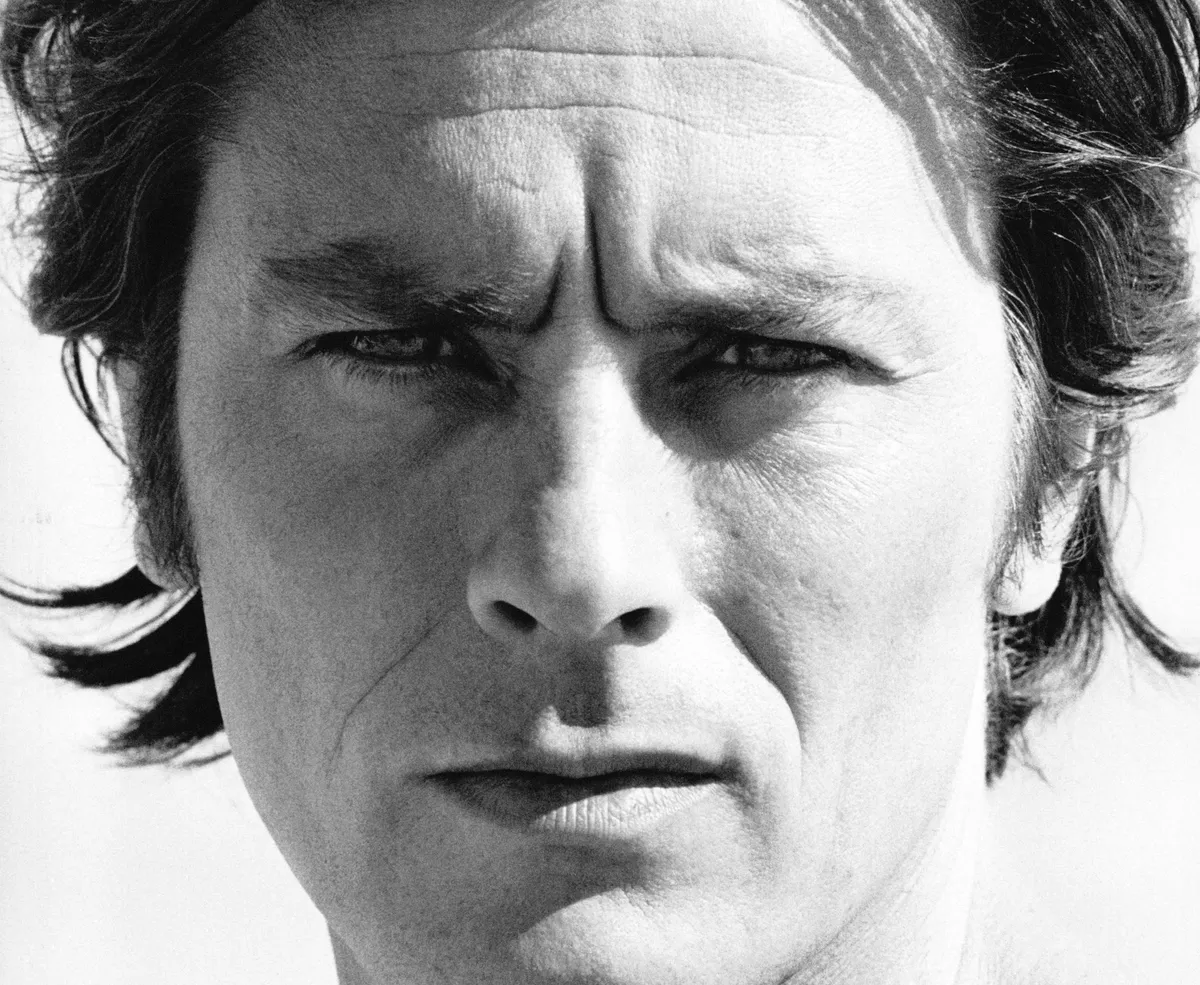
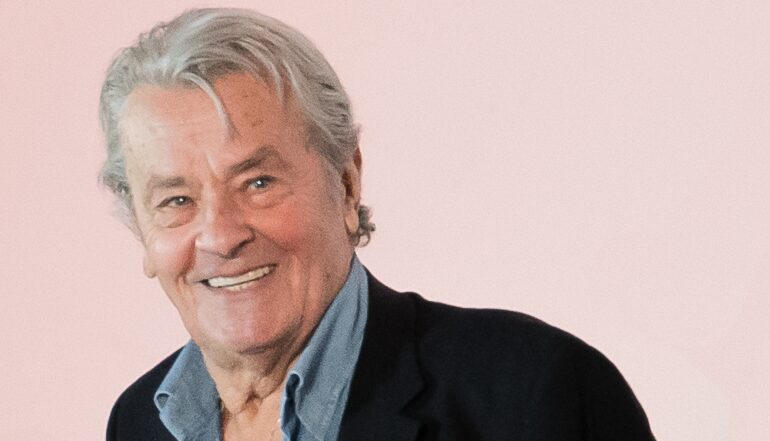
Alain Delon, the brooding French star whose smoldering performances captivated cinema, dies at 88.
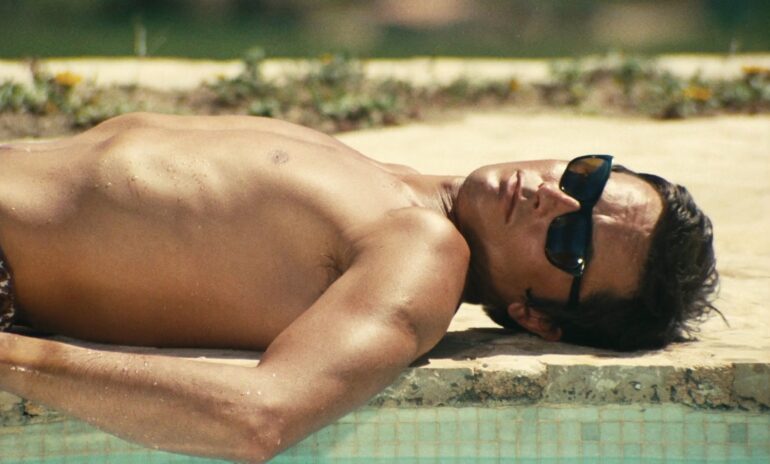
Alain Delon in “La Piscine”
Alain Delon, the enigmatic and undeniably handsome star of French cinema, passed away at 88. Known for his smouldering presence and captivating performances, Delon was a cornerstone of European cinema in the 1960s and 1970s, working with some of the most revered directors. His death marks the end of an era in film history, as he leaves behind a legacy that has profoundly influenced the French and international film industries.
The Rise of a Cinematic Icon
Born on November 8, 1935, in Sceaux, France, Alain Delon’s early life was marked by instability. After his parents divorced, Delon’s rebellious nature saw him expelled from multiple schools. Later, a brief stint in the French Navy during the First Indochina War resulted in a dishonourable discharge. Yet, these turbulent beginnings shaped the raw intensity he would bring to his acting career.
Delon’s break into the film industry was serendipitous. In 1957, he was discovered by a talent scout at the Cannes Film Festival. Soon after, he received offers from Hollywood but chose to remain in France, where he began working with renowned directors like René Clément and Yves Allégret. His first significant role came in Clément’s “Plein Soleil”(“Purple Noon”) in 1960, where Delon’s portrayal of Tom Ripley, a cunning and murderous conman, captivated audiences and critics alike. His performance in this film would set the tone for the brooding, complex characters for which he would become famous.
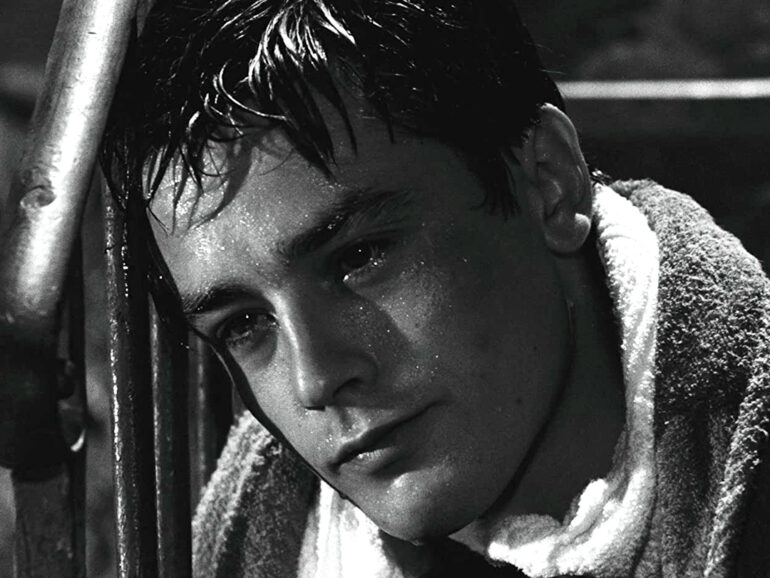
Alan Delon in “Rocco and His Brothers”
Collaborations with Great Directors
The 1960s and 1970s were the golden years of Alain Delon’s career. During this time, he collaborated with some of Europe’s most acclaimed filmmakers, solidifying his status as an international star. In 1960, Delon starred in Luchino Visconti’s “Rocco and His Brothers,” a film showcasing his ability to convey vulnerability and strength simultaneously. His performance as Rocco, a young man caught between loyalty to his family and his desires, was hailed as one of his best.
Visconti and Delon would collaborate again in 1963 on “Il Gattopardo” (“The Leopard”), where Delon played the dashing Tancredi opposite Burt Lancaster. This film, an epic tale of a Sicilian prince’s struggle to preserve his family and fortune during the Italian unification, further cemented Delon’s reputation as a leading man with depth and charisma.
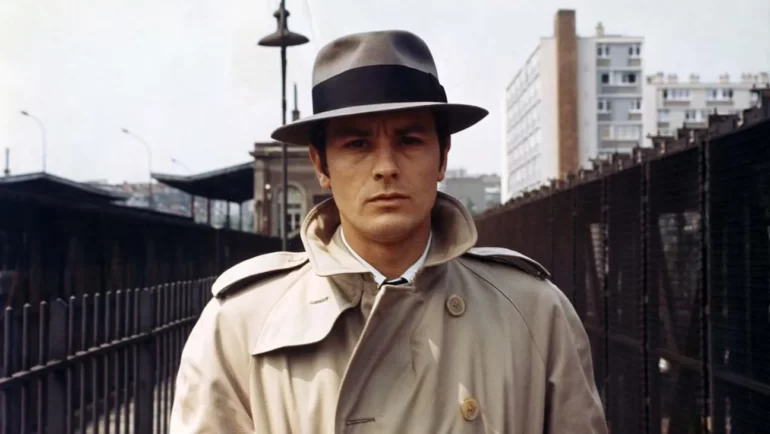
Alan Delon in “Le Samouraï”
Jean-Pierre Melville, the godfather of the French New Wave, also recognized Delon’s unique talent. Melville cast him as the stoic hitman Jef Costello in “Le Samouraï” (1967), a role that became one of Delon’s most iconic. His portrayal of Costello, a cold and calculated assassin, remains a defining moment in his career, blending elements of film noir with a distinctly European sensibility. Delon and Melville would continue their successful partnership in films like “Le Cercle Rouge” (1970) and “Un Flic” (1972), further exploring themes of isolation, loyalty, and moral ambiguity.
A Star Beyond Borders
While Delon’s fame was primarily rooted in Europe, he also attempted to conquer Hollywood. However, despite his undeniable talent and good looks, he never achieved the same success in the United States as in France. His first American film, “The Yellow Rolls-Royce” (1964), performed moderately well at the box office. Still, his other ventures, including “Once a Thief” (1965) and “Texas Across the River” (1966), failed to make a significant impact.
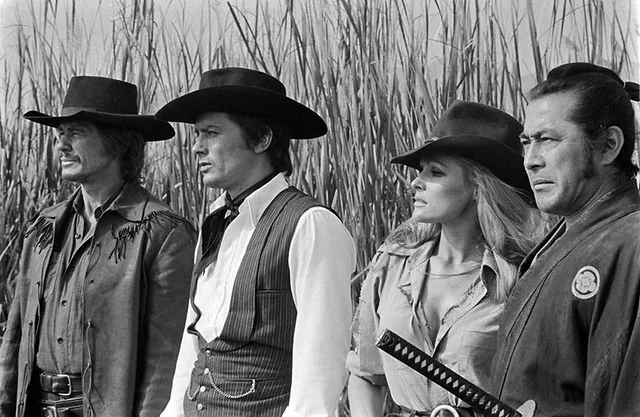
Despite this, Delon remained a beloved figure in international cinema, particularly in Japan, where he was regarded as a Western star. His collaboration with Japanese actor Toshiro Mifune in “Red Sun” (1971) is a testament to his broad appeal and versatility.
Charles Bronson, Alain Delon, Ursula Andress and Toshiro Mifune in “Red Sun”
The Complex Persona of Alain Delon
Alain Delon’s on-screen personas often mirrored his real-life complexities. Known for his striking good looks, Delon was frequently compared to other male icons like James Dean and Paul Newman. However, his beauty carried a sense of mystery and danger, elements often highlighted in his roles as gangsters, assassins, and morally ambiguous characters.
Off-screen, Delon was no stranger to controversy. His involvement in the unsolved murder of his bodyguard, Stevan Markovic, in 1968 brought about a scandal that rocked French society. Although Delon was never charged, the case remains a dark chapter in his life. Additionally, his outspoken views on various social and political issues, including statements that were perceived as homophobic and racist, added to his complex and often polarizing public image.
Despite these controversies, Delon’s contributions to cinema cannot be understated. In 1984, he was awarded the César for Best Actor for his role in Bertrand Blier’s “Notre Histoire,” in which he played a middle-aged alcoholic searching for redemption. This recognition came late in his career, but it was a fitting tribute to an actor who had given so much to the art form.
Alain Delon‘s personal life was as intense and dramatic as the characters he portrayed on screen, defined by a series of passionate and often tumultuous relationships. His first significant love was the German actress Romy Schneider, whom he met in 1958 on the set of the film “Christine.” Their romance captivated the public, and they became one of Europe’s most famous couples. Despite their engagement, the relationship ended in 1963, reportedly due to Delon’s infidelity. Despite their split, both actors continued to speak fondly of each other, with Schneider’s tragic death in 1982 profoundly affecting Delon.
Following his split with Schneider, Delon had several high-profile relationships, including a notable affair with French actress Nathalie Delon. The two married in 1964 and had a son, Anthony Delon. However, their marriage was short-lived, ending in divorce in 1969.
Delon’s later relationships included a long-term romance with Mireille Darc, another iconic French actress from the late 1960s until the early 1980s. Darc, often described as Delon’s “soulmate,” remained a significant figure in his life even after their separation. In the following years, Delon also had relationships with model Rosalie van Breemen, with whom he had two children, Anouchka and Alain-Fabien, and the renowned French-Italian singer Dalida.
A Lasting Legacy
Alain Delon’s influence on cinema is undeniable. His work has inspired generations of actors and filmmakers, and his films continue to be celebrated for their style, substance, and emotional depth. Even in his later years, Delon remained a figure of fascination and respect. In 2019, he was awarded an honorary Palme d’Or at the Cannes Film Festival, recognizing his enduring impact on the film world.
Delon’s legacy also lives on through his children, Anthony, Anouchka, and Alain-Fabien, who were by his side in his final moments. In recent years, Delon had suffered from declining health, including a stroke in 2019, but he remained a towering figure in the world of cinema until the very end.
Rome is once again expanding the scope of its Film Fest: thirteen days of cinema, international premieres, renowned auteurs, emerging talent, series, documentaries, and cinematic heritage—with Javier Bardem, Paolo Genovese, and Monica Vitti at the heart of an edition that …
Javier Bardem will be one of the major guests of the Rome Film Fest 2026, receiving the Lifetime Achievement Award and presenting Rodrigo Sorogoyen’s El ser querido.