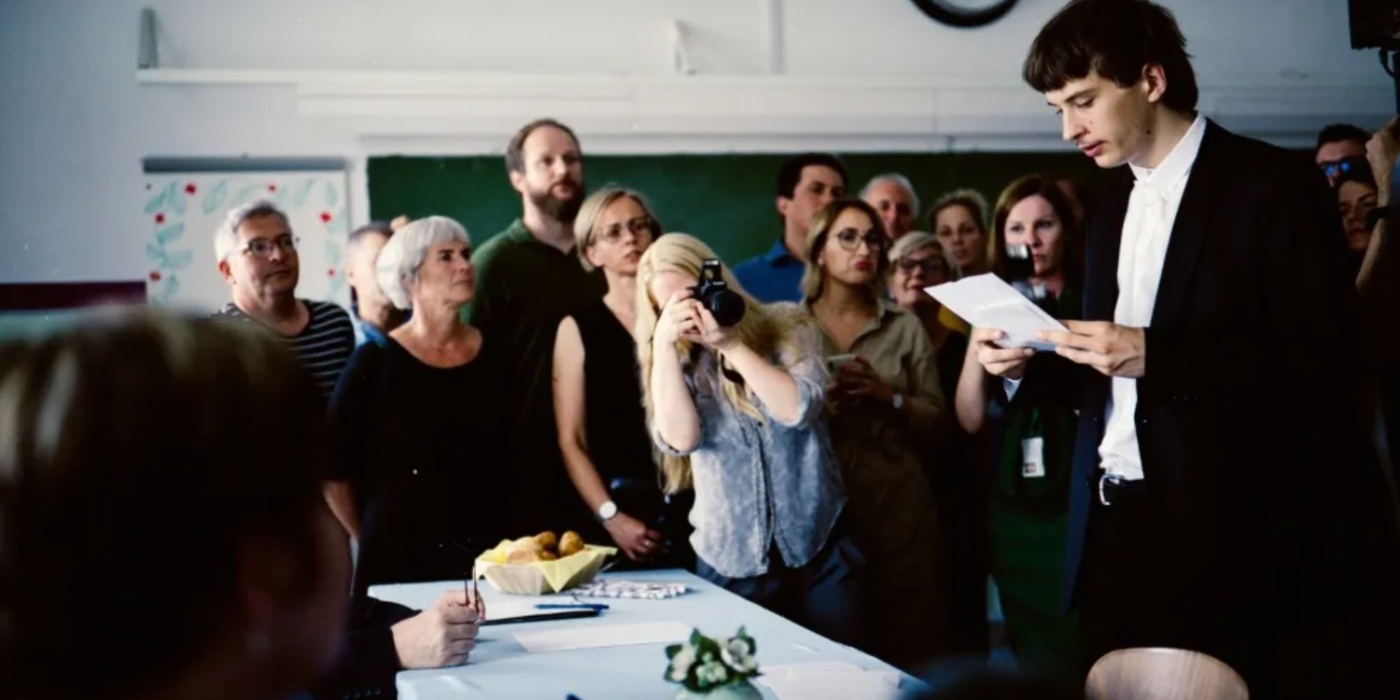
At the 80th Venice Film Festival in the section Orizzonti, “Explanation for Everything” emerged as a compelling exploration of society’s complexities and the uncharted territory of youth in Hungary. Fred Film Radio had the privilege of interviewing Hungarian director Gábor Reisz, the creative mind behind this thought-provoking film, which marks his third feature after “For Some Inexplicable Reason” and “Bad Poems.”
Exploring society’s complexities
The journey of “Explanation for Everything” began with a simple idea, one that would eventually unravel into a captivating narrative. The film tells the story of a student who wears a nationalist badge during a crucial exam, only to fail and resort to deception when facing his father. It was this initial premise that ignited the creative spark for Gábor Reisz and his co-screenwriter Éva Schulze, who served as both mentor and teacher.
A unique approach to character construction
During the initial phases of development, Gábor Reisz took a unique approach to character construction. He immersed himself in the characters’ world by writing in the first person singular for three months. This deep dive allowed him to craft multifaceted characters that would be central to the film’s narrative.
The turning point in the film’s creative process came with the decision to start the story on the night before the exam. This choice presented the opportunity to explore every facet of the characters’ lives, delving into their motivations, fears, and aspirations. With the story now in motion, the team quickly moved from script to shooting, embarking on a journey that would captivate audiences.
“Explanation for Everything” is a personal exploration of youth
While “Explanation for Everything” delves into the intricacies of Hungarian youth, it was not born out of political motivation. Instead, it evolved from personal experiences and observations. During the film’s inception, Hungary witnessed a student blockade, a protest against educational reforms. Artists, including filmmakers, rallied in support of these young protesters, inspiring Gábor Reisz to explore their stories and motivations.
The heart of the film beats to the rhythm of education—a theme that resonates deeply with the director. The pressure exerted by parents, the pursuit of academic success, and the role of a history teacher become focal points within the narrative. It’s a reflection of the challenges faced by youth when navigating the delicate transition from adolescence to adulthood.
Balanced portrayals and nuanced themes
One of the film’s remarkable achievements is its avoidance of excessive political Manicheism. Gábor Reisz takes a balanced approach, mirroring his own uncertainty about political affiliations. The characters are presented in their entirety, showcasing both positive and negative aspects. This nuanced portrayal extends to society itself, highlighting the traumas and grievances of both political camps.
“Explanation for Everything” also addresses the influence of media hype and fake news. This theme draws from the distortions observed during the film school protests, shedding light on the power of media in shaping perceptions.
Narrative complexity and experimental storytelling
The film’s narrative structure, spanning ten days with distinct chapters for each character, adds a layer of complexity and engagement. Gábor Reisz finds joy in experimental storytelling, embracing the challenge of crafting a narrative that resonates in a landscape filled with countless stories.
In terms of mise en scène and photography, the film adopted a Dogma-style approach due to budget constraints. Natural light, minimal camera movements, and realistic sets created an authentic atmosphere. This approach allowed for flexibility and improvisation, enhancing the film’s authenticity.
As “Explanation for Everything” prepares for its release in Hungary on October 5, the director remains open to diverse reactions. He hopes that the film will serve as a catalyst for dialogue and debate, bridging the gaps in a society marked by complexity and a need for communication.
Plot
It’s summer in Budapest, high school student Abel is struggling to focus on his final exams, whilst coming to the realisation that he is hopelessly in love with his best friend Janka. The studious Janka has her own unrequited love with married history teacher Jakab—who had a previous confrontation with Abel’s conservative father. The tensions of a polarised society come unexpectedly to the surface when Abel’s history graduation exam turns into a national scandal.