Presented in the Un Certain Regard section of the Cannes 2026 film festival, Ulya marks the latest feature by Latvian filmmaker Viesturs Kairiss. The film is a co-production involving Latvia, Lithuania, Estonia and Poland, and focuses on the early years of legendary basketball player Ulyana Semyonova, one of the most dominant athletes in women’s basketball history.
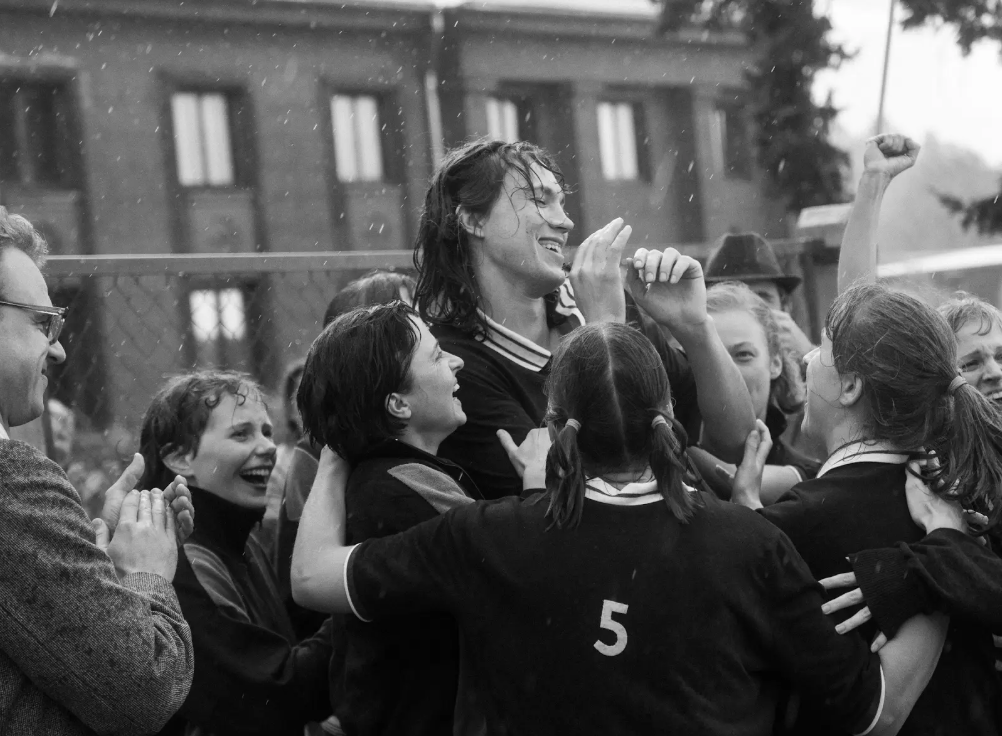
Set in Soviet Latvia in 1964, the film follows teenage Ulya, an Old Believer girl growing up in a remote rural community. Nearly two meters tall, she struggles to find her place in a world that sees her only through her physical difference. When a school photograph reaches basketball scouts in Riga, she is brought into the Soviet sports system and pushed toward a destiny she never fully chose for herself.
For Kairiss, however, the film was never intended as a conventional sports biopic. “I’m not interested in legends in that sense,” the director explained. “I wanted to make a film about a human being and about how difficult it is to accept yourself when the world constantly asks you to conform.”
An Unconventional Casting Choice
One of the most striking aspects of Ulya is the decision to cast Latvian actor Kārlis Arnolds Avots in the role of Ulya. According to Kairiss, the idea did not emerge from a conceptual provocation but directly from the actor himself.
The director recalled that Avots had long been obsessed with the idea of portraying Semyonova, initially imagining the project for the stage. Only later did Kairiss realise the cinematic potential of such an approach. “In theatre, a male actor playing a female role is something familiar,” he said. “In cinema it felt almost impossible. That impossibility immediately attracted me.”
The choice became central to the film’s emotional and thematic identity. Rather than focusing on realism or imitation, Ulya explores the universal feeling of being perceived as different, alien or excessive within society.
For Kairiss, the character’s struggle transcends gender or sport. “Every person has an inner giant or an inner freak,” he noted. “At some point in life, you have to decide whether to hide it, destroy it or accept it.”
Soviet Latvia and the Politics of Identity
While deeply intimate, Ulya also carries a strong political dimension. Set during Latvia’s occupation by the Soviet Union, the film portrays a society shaped by ideological control and cultural suppression.
Kairiss stressed the importance of revisiting this historical context today, particularly against the backdrop of the ongoing war in Ukraine and renewed fears across the Baltic region. The director described Semyonova as a symbolic figure for Latvians of that era because, despite being Russian, she publicly embraced the Latvian language and identity at a time when Soviet authorities encouraged cultural assimilation.
“For Latvians, she represented a possibility of remaining ourselves,” the filmmaker explained. “Even small gestures carried political meaning during those years.”
Rather than reconstructing history as distant memory, the director approached the period through contemporary resonance. Themes of visibility, exclusion and social pressure remain central to the film’s emotional landscape.
Beyond the Sports Film Formula
Unlike traditional sports dramas built around victories and championships, Ulya deliberately avoids triumphalist storytelling. The narrative remains anchored in the protagonist’s adolescence and emotional development rather than her future fame.
According to Kairiss, this decision allowed the film to escape familiar genre clichés and move closer to an arthouse sensibility focused on vulnerability and identity. Ulya’s central conflict is not whether she can become a champion, but whether she can exist beyond the expectations imposed on her body.
The film gradually frames basketball not simply as competition, but as the only space where Ulya’s physicality acquires meaning rather than shame. Yet even success cannot entirely resolve her desire for ordinary human connection.
Reflecting on the film’s deeper message, Kairiss said that Ulya ultimately taught him the importance of recognising one’s own path in life. “You must understand your destiny and follow it,” he observed. “Sometimes instinct is the only thing guiding you.”
Plot
Soviet Union, Latvia, 1964. Ulya, an Old Believer teenage girl nearing two meters tall, grows up on a faraway country farm. Her unusual height troublesher family, who wonder if there’s a place for her in the world. When her class photo reaches basketball coaches, Ulya is whisked to capital Riga to join a famous basketball team. Struggling with her height and identity, she trains hard, but realizes basketball can’t fulfill her dream of a normal life. Afterfleeing back home, Ulya discovers both village life and basketball see her only for her height. Accepting herself, she faces a choice: hide or aim to bethe best basketball player in the world.