


“Human consent has to be front and centre”: Cate Blanchett on AI, cinema and the future of the human hand
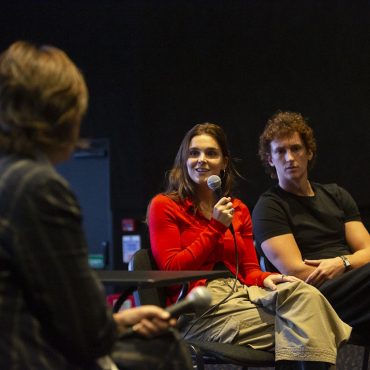
Cate Blanchett at Cannes 2026: a cinephile Rendez-vous on TÁR, AI, festivals, craft, equality and the human hand in cinema.
Listeners:
Top listeners:
 play_arrow
ENGLISH Channel 01 If English is your language, or a language you understand, THIS IS YOUR CHANNEL !
 play_arrow
ITALIAN Channel 02 Se l’italiano è la tua lingua, o una lingua che conosci, QUESTO È IL TUO CANALE!
 play_arrow
EXTRA Channel 03 FRED Film Radio channel used to broadcast press conferences, seminars, workshops, master classes, etc.
 play_arrow
GERMAN Channel 04 Wenn Ihre Sprache Deutsch ist, oder Sie diese Sprache verstehen, dann ist das IHR KANAL !
 play_arrow
POLISH Channel 05
 play_arrow
SPANISH Channel 06 Si tu idioma es el español, o es un idioma que conoces, ¡ESTE ES TU CANAL!
 play_arrow
FRENCH Channel 07 Si votre langue maternelle est le français, ou si vous le comprenez, VOICI VOTRE CHAINE !
 play_arrow
PORTUGUESE Channel 08
 play_arrow
ROMANIAN Channel 09 Dacă vorbiţi sau înţelegeţi limba română, ACESTA ESTE CANALUL DUMNEAVOASTRĂ!
 play_arrow
SLOVENIAN Channel 10
 play_arrow
ENTERTAINMENT Channel 11 FRED Film Radio Channel used to broadcast music and live shows from Film Festivals.
 play_arrow
BULGARIAN Channel 16 Ако българският е вашият роден език, или го разбирате, ТОВА Е ВАШИЯТ КАНАЛ !
 play_arrow
CROATIAN Channel 17 Ako je hrvatski tvoj jezik, ili ga jednostavno razumiješ, OVO JE TVOJ KANAL!
 play_arrow
LATVIAN Channel 18
 play_arrow
DANISH Channel 19
 play_arrow
HUNGARIAN Channel 20
 play_arrow
DUTCH Channel 21
 play_arrow
GREEK Channel 22
 play_arrow
CZECH Channel 23
 play_arrow
LITHUANIAN Channel 24
 play_arrow
SLOVAK Channel 25
 play_arrow
ICELANDIC Channel 26 Ef þú talar, eða skilur íslensku, er ÞETTA RÁSIN ÞÍN !
 play_arrow
INDUSTRY Channel 27 FRED Film Radio channel completely dedicated to industry professionals.
 play_arrow
EDUCATION Channel 28 FRED Film Radio channel completely dedicated to film literacy.
 play_arrow
SARDU Channel 29 Si su sardu est sa limba tua, custu est su canale chi ti deghet!
 play_arrow
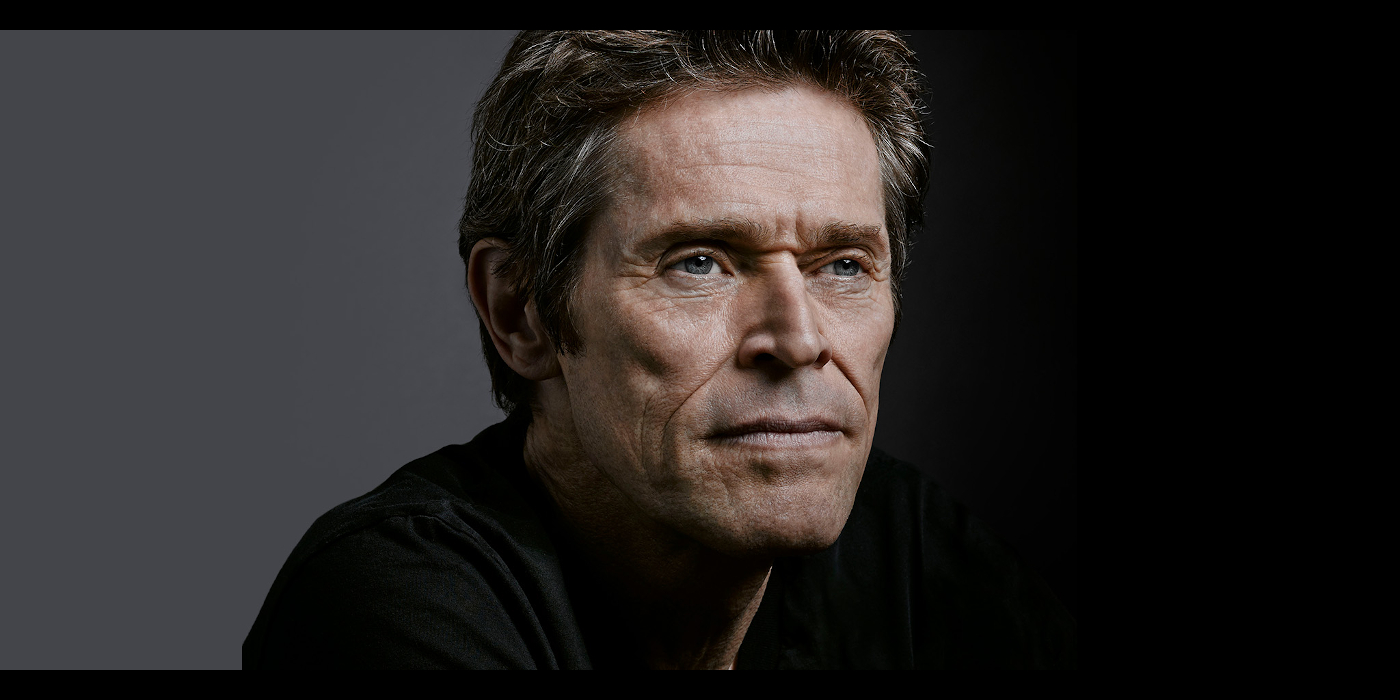
“Conversation with” at the 20th Marrakech IFF, interview with actor Willem Dafoe Bénédicte Prot
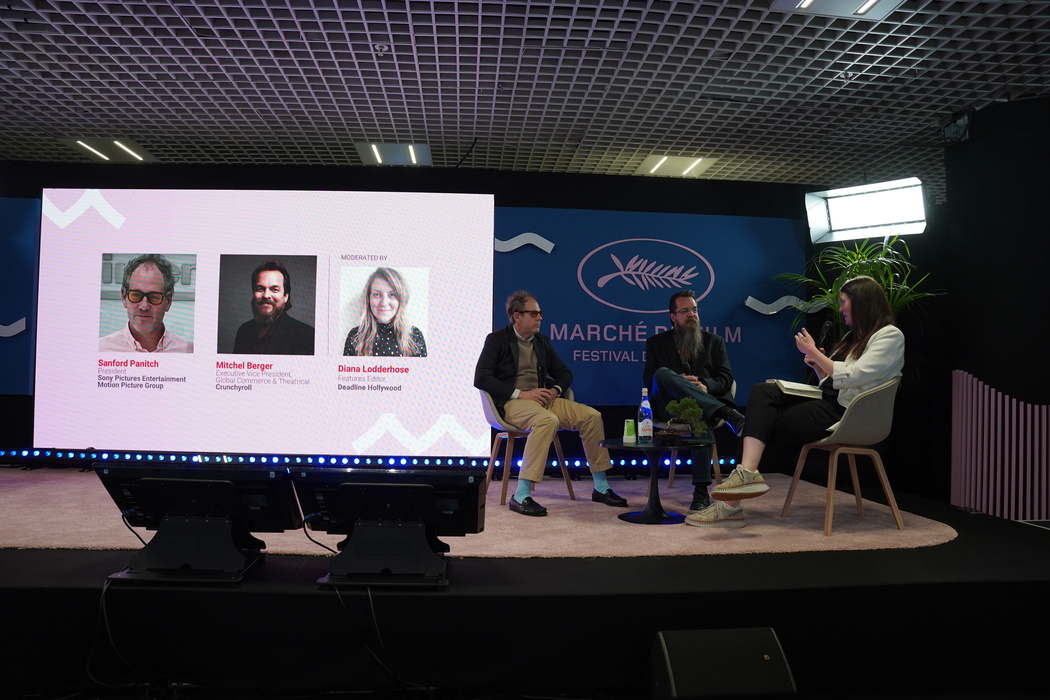
At the Marché du Film of the 79th edition of Cannes International Film Festival, during a year in which Japan held a particularly visible place within the market’s programme as Country of Honor, one of the most revealing conversations was not only about anime as a booming sector, but about anime as a new central language of global cinema. As part of the Cannes Animation Programme, the panel “Cinema, Storytelling, and the Rise of Global Anime | Presented by Crunchyroll & Sony Pictures Entertainment” brought together Mitchel Berger, Executive Vice President, Global Commerce & Theatrical at Crunchyroll, and Sanford Panitch, President of Sony Pictures Entertainment Motion Picture Group, to discuss the evolution of anime from a passionate niche to one of the most powerful forms of contemporary screen culture.
One of the most important distinctions made during the panel concerned the very definition of anime. Mitchel Berger pushed back against the tendency to describe anime as a genre, insisting instead on its nature as a medium, a way of telling stories rather than a fixed category of stories.
“What I really love about anime is the creators and the artists who do this work pour so much of their heart and soul into this. And at the end of the day, anime’s not a genre. It’s a medium. It’s just a way of telling stories. So when you look at animation, whether it’s stop motion or 2D cell shading or CGI or whatever, it is a way of telling stories. Anime is one way of telling those stories within the animation umbrella.”
For Berger, anime belongs within the broader family of animation, but it also has a distinct identity rooted in Japanese creative practice. Animation itself is global but anime, however, is marked by the fact that it is “conceived of or created in Japan”, shaped by Japanese studios and filtered through a visual, emotional and narrative system that gives it its recognizable character.
That does not mean that anime is closed off from the rest of the world. On the contrary, Berger repeatedly emphasized that stories can come from anywhere. He mentioned Solo Leveling, adapted from a Korean webtoon, Radiant, based on a French manga, and Crunchyroll’s work on an anime adaptation of the Sony video game Ghost of Tsushima. The source material may be Korean, French, American, or entirely original, but what matters is what happens when it enters the Japanese anime ecosystem.
“Great stories come from anywhere across the world”, Berger said “I think you can take those and then tell them all through the medium that is anime.”
A second central theme was the relationship between streaming and cinema. In a film industry where often there is a tendency to frame platforms and theatrical exhibition as opposing forces, Mitchel Berger offered a different model: one in which the two experiences are complementary.
Crunchyroll’s position is unusual in this sense. It is a streaming platform, but also a theatrical distributor, a marketing engine, a consumer products company and a gateway into fandom. According to Berger, series such as Demon Slayer, Chainsaw Man and Jujutsu Kaisen build their audiences over time on streaming platforms, allowing fans to develop long-term emotional relationships with characters and worlds. The cinema then becomes not an alternative to streaming, but the next stage in that relationship.
“You see a lot of shows that will premiere episodes from a new season or recap films in the theater, because that experience on a giant screen with amazing sound is truly unique. It’s just something you can’t replicate somewhere else. The way I like to describe it is music, like listening to an album or watching a band performing live. That’s what cinema is for me with anime. You can watch stuff on our streaming service Crunchyroll, and you can have a really specific experience with it. Then you can watch the same content, the same characters, the same stories on the big screen and have a fundamentally different experience that still fulfills this emotional need in you. That’s why for me, streaming and cinema don’t have to be at odds with each other. They can be very complementary because they serve different needs for the fan”.
In this view, anime has become one of the most effective bridges between the streaming generation and the theatrical experience. Fans discover and follow a franchise online, but the cinema offers them something that cannot be replicated at home: scale, sound, collectivity, ritual.
The discussion repeatedly returned to younger audiences. For Berger, anime’s power lies in its ability to reach Gen Z and Gen Alpha not as a subculture, but as part of their normal media diet. Anime, he argued, is no longer “counter-culture,” no longer “alternative,” no longer “on the fringes.” For younger viewers, it is simply part of how they consume stories.
Crunchyroll’s research, cited during the panel, indicates that among consumers aged 13 to 54, around 44% identify as anime fans, with the percentage growing as the demographic becomes younger. The implication is significant: anime is not merely attracting existing cinephiles into theaters, but may be helping create the next generation of moviegoers.
Berger linked this to a broader concern after the pandemic: the possible loss of the habit of going to the movies. In his youth, he recalled, people did not necessarily go to see a specific film; they simply “went to the movies.”
“We proved coming out of the pandemic with Demon Slayer: Mugen Train, we can activate that fan base and get them back into cinema” he said.
Sanford Panitch from Sony Pictures agreed, observing that while older audiences have been slower to return to theaters after Covid, the 18–34 demographic has opened up in important ways. Anime is part of that shift because it is based on fanship, community and shared emotional intensity. For younger audiences, the theater is not merely a commercial venue: it is a place where online fandom becomes embodied.
Berger put it simply: “There’s no better place to find 200 people who like the same thing you do than to watch a movie together”.
The panel inevitably focused also on Demon Slayer, whose theatrical success has become a landmark case in the global expansion of anime cinema. Berger referred to the franchise’s worldwide performance as “nearly 800 million worldwide,” describing the result as astonishing even for a company that already knew the depth of its fan base.
“We knew that we had a dedicated and radical base”, he said, “but the level to which that came out and supported it was truly astonishing.”
For Crunchyroll, the success of Demon Slayer was not an isolated miracle. It was the result of years of audience-building, close collaboration with partners such as Aniplex and Ufotable, and a clear creative decision: to treat the culmination of a major story arc as something that deserved the big screen.
“What I love about the release, more than anything”, Berger said, “is the fact that Aniplex and Ufotable looked at this ultimate mark of the series and said: this deserves to be seen on the big screen”.
Panitch framed the impact of Demon Slayer in even broader industrial terms. For Sony, it was not only an anime success, but one of the company’s biggest films of the year. It functioned, he suggested, as a wake-up call for the rest of the industry, proving that anime could generate blockbuster-level theatrical results across territories where such performances had not previously been expected.
The lesson was not only that anime has an audience, but that this audience can be activated globally when marketing, distribution, local knowledge and fan authenticity are aligned.
Another key theme was the partnership between Crunchyroll and Sony. Berger described it as “the best of both worlds”: Crunchyroll brings deep anime expertise, community knowledge and direct access to fans; Sony brings a global distribution apparatus with more than 50 offices around the world.
“You have a major studio, you have a very, very anime-focused company” Berger said “When those two things come together, you’re then able to leverage the strengths of both”.
The strength of the partnership lies in the fact that anime cannot be marketed simply like any other blockbuster. It requires knowledge of the titles, sensitivity to the fandom, and an understanding of how different territories respond. What works in France may not work in the UK; what works in Brazil may require a different approach from Southeast Asia or India. Berger emphasized that the flow of knowledge goes both ways. Crunchyroll can explain the nuances of a title like Demon Slayer, but local Sony teams can explain how to activate the audience in each market. That conversation, he suggested, is one reason smaller territories performed so well.
The European market emerged as a particularly important part of the conversation. Mitchel Berger pointed to EMEA as a major growth opportunity, because much anime originates in manga. Where manga culture is already strong, theatrical anime has an existing cultural foundation.
But both Berger and Panitch also made clear that growth is not limited to Europe. India, Southeast Asia and Brazil were mentioned as major areas of opportunity. What connects these territories is not identical market behavior, but the urge of anime to be identified as a mainstream emotional and cultural language for younger viewers.
What emerged the most from the Cannes panel was a portrait of anime as one of the most dynamic forces in contemporary cinema. It is at once Japanese and global, digital and theatrical, serialized and cinematic, fan-driven and artist-led. It can transform Korean webtoons, japanese manga, video games or original ideas into a medium with a distinctive emotional and visual grammar.
But perhaps the most important idea was this: anime is not succeeding because it imitates Hollywood. It is succeeding because it offers something Hollywood increasingly needs, which is devoted communities, younger audiences, strong visual identity, global circulation, and a renewed belief in the collective experience of watching images on a big screen.
For Mitchel Berger and Sanford Panitch, the role of a company like Crunchyroll is ultimately emotional. On one side is a filmmaker with a story to tell; on the other is a fan with an emotional need. The task is to connect them. “We’re offering a way for that filmmaker’s voice to connect with that fan’s ear”, Berger said, “and create an emotional reaction”.
And hearing those words in Cannes, in the middle of the world’s most important film market, is something that now sounds less like a niche strategy, and more as a possible roadmap for the future of cinema itself.
Cate Blanchett at Cannes 2026: a cinephile Rendez-vous on TÁR, AI, festivals, craft, equality and the human hand in cinema.
We discover, through the words of its director Alessandro Voglino, how the Film Commission Abruzzo is revitalizing the region’s cinema industry with €4M funding, fostering local talent, and attracting international productions.
Discover Ting, a dark fantasy period drama set in 1918 Italy, blending compelling coming-of-age storytelling with striking historical and fantastical elements. This interview was recorded in collaboration with Cinema&Video International at the 79th Cannes Film Festival.
Park Chan-wook will preside over the Jury at the 79th Festival de Cannes, marking a historic first for Korean cinema.
Character designer Thibault Leclercq talks about Wildwood and its stop-motion puppets, at the 24th edition of Alice nella Città.
Edinburgh Spanish Film Festival
Marian Arechega, director of the vibrant Edinburgh Spanish Film Festival, discusses the 2026 edition programme, showcasing recent and diverse cinema from Spain.
Nicolas Winding Refn on Her Private Hell, his first feature in ten years, in Italian cinemas from October 1.
Discover how EWIP - European Work in Progress connects European and African films with top buyers, boosting distribution and festival success.