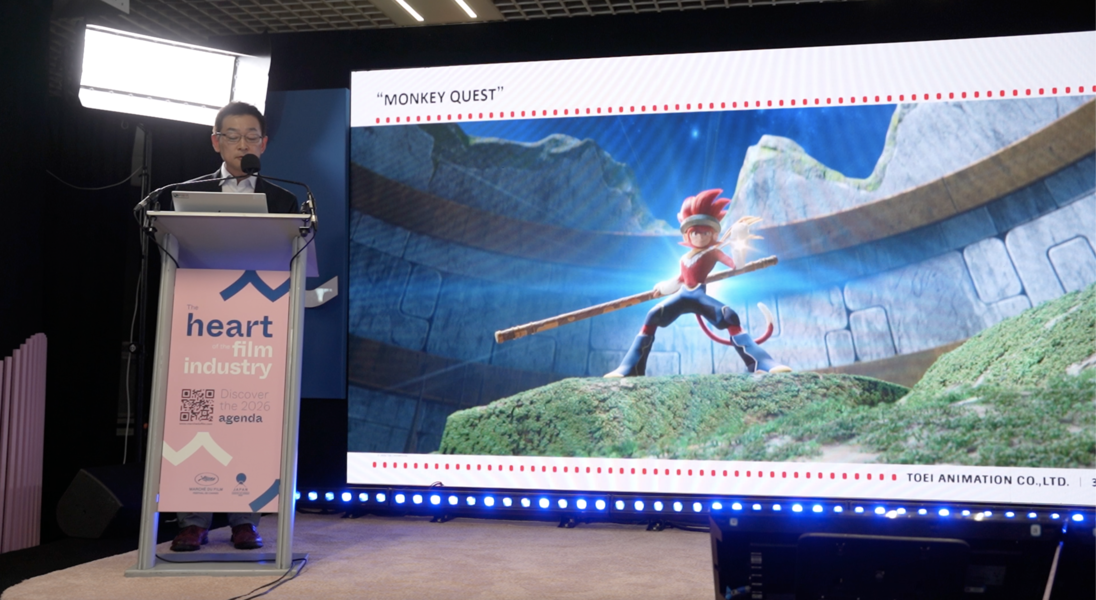
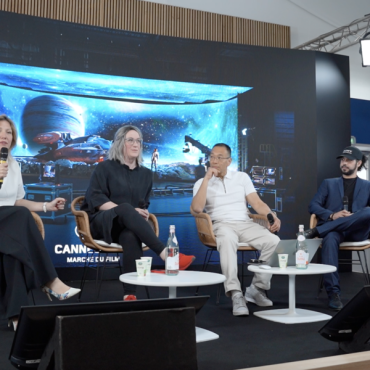
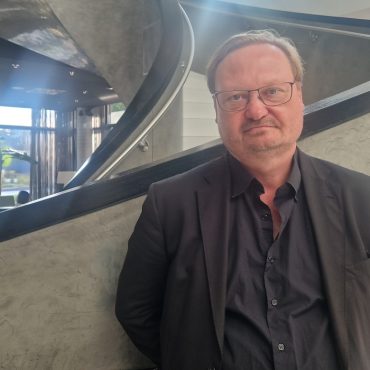
At the Marché du Film, during the 79th edition of the Cannes International Film Festival, Japan’s audiovisual industry and animation occupied a central place in the international market conversation. And here, one of the main Japanese animation studios, Toei Animation, presented a corporate update that worked more as a true statement of intent. The panel brought together Yosuke Asama, General Manager of Toei Animation, and producer Yoshi Ikezawa, who both used the company’s 70th anniversary as a starting point to reflect on the evolution of Japanese anime, its global rise, and the new creative frontier represented by international co-productions.
Toei Animation: from “Disney of the Orient” to a global anime powerhouse
Yosuke Asama opened the session recalling his first real contact with the international landscape, making him realize “just how different creating animation it was in Japan”. And his conclusion was blunt: Japanese producers had not always made enough effort to understand the global market, partly because the domestic market had already been so successful.
“I felt Japanese producers aren’t trying to understand the global market”, he said. “It’s because we’ve already achieved such great success domestically in Japan. So I thought Japan had to learn about the world. And I believed that if we didn’t, we would eventually become the losers.”
That sense of urgency framed his overview of Toei Animation’s history. Founded in 1956, the company is now celebrating its 70th anniversary, after having produced more than 500 television and feature titles and nearly 15,000 episodes. Asama traced that story back to an almost mythic beginning: a time when Japan had no established animation technology and Toei entered the field by embracing possibility itself. He recalled the company’s first feature-length challenge, inspired by an ancient Chinese story, and the use of rotoscope technique, with live-action footage shot first and then drawn frame by frame. He also invoked the famous ambition of Toei’s first president, Hiroshi Okawa, who declared that the studio would become the “Disney from Orient.”
“Japanese culture doesn’t divide adult and child so strictly than other countries”, Asama said. “That’s why we did it freely so unexpectedly we could break the old animation style. These works became known as anime.”
Anime’s long road to global recognition
One of the most interesting aspects of Yosuke Asama’s intervention was his insistence that anime’s current global boom did not appear out of nowhere. On the contrary, he presented it as the delayed recognition of a form that had continued to grow in Japan even when foreign markets misunderstood or rejected it. During the 1990s, he noted, some countries banned anime from television because they considered its content too intense or inappropriate. Yet in Japan, anime continued to expand. New genres, new themes and new audiences emerged year after year. Children still watched animation, but they were no longer its only audience. “Anime was growing up silently only in Japan”, Asama observed.
Then came the last five to ten years: streaming platforms, new viewing habits, global fandom and the rediscovery of anime as a central form of contemporary visual culture. Asama described this moment almost as a second arrival. After more than two decades of distance, international audiences seemed to discover again that Japanese anime had not lost its force. “Worldwide people said: wow, Japanese anime still has a power”, he said. “I think that now, anime is recognized as one of the major visual expression”. For Asama, anime is not only a category of content that travels well. It is now one of the major visual languages of the present. And for Toei Animation, a studio that helped define the form through franchises and characters known across generations, this recognition creates both an opportunity and a responsibility.
Toei Animation’s global expansion, without losing the Japanese foundation
If Asama’s role was to situate Toei’s present within its seventy-year history, Yoshi Ikezawa’s task was to explain where the company is going next. His first point was clear: Toei’s global strategy does not mean abandoning Japanese anime. It means building from it. “Our foundation is Japanese anime” Ikezawa said. “And the creative strength that we built in Japan. And we are very proud of it. And that will not change”. Toei indeed does not want to change who it is. It wants to use its identity as the basis for new collaborations.
“When we talk about global endeavor”, he explained, “we are not talking about changing who you are. We are talking about building on our history”. That idea led to the core thesis of the panel: anime can support not only stories born in Japan, but stories rooted in other regional cultures. For Yoshi Ikezawa, this does not mean simply applying “anime aesthetics” to foreign material. It means a deeper, slower and more respectful process. “Stories are rooted in your regional culture”, he said “and Japanese anime can support not only stories from Japan. It can also support the stories born in other cultures. And this is not simply exploring style or anime aesthetics. It means listening. And it means working together. And it means respecting each regional culture and each partner.”
Anime as a storytelling method, not only a genre
One of the strongest ideas to emerge from the panel was Ikezawa’s definition of anime. “Japanese anime is not only a type of content or genre”, he said. “It is also a powerful way of telling stories”. This formulation helps explain why Toei Animation sees young global audiences as particularly receptive. For generations raised on streaming, fandom, digital platforms and transnational pop culture, anime is not foreign in the way it might once have been perceived. It is familiar, legible, emotionally direct and formally flexible.
Yoshi Ikezawa emphasized that anime can carry many tones and genres: action, comedy, drama, fantasy, friendship, emotion, dreams and hopes. It can speak to children, teenagers, adults and families. In this sense, anime becomes less a niche and more a shared grammar and a way of expression capable of moving across borders while still preserving cultural specificity. This is where Toei’s strategy becomes especially interesting. The company does not seem to be arguing that every culture should become Japanese in order to make anime. Instead, it suggests that anime has become a language through which different cultures can express themselves.
“Monkey Quest” and the North American challenge
The most concrete symbol of this next phase is Monkey Quest, described by Yoshi Ikezawa as one of Toei’s most important new challenges in North America. The project is a feature film and, according to Ikezawa, an attempt to explore “family animation rooted in North American culture, created through the strength of Japanese anime”.
“This is not a replacement for our core business”, he said. “It is an extension of it. And our goal is to create something that only Toei Animation can create”. Monkey Quest is indeed not presented as Toei becoming an American studio, nor as a Japanese studio simply imitating Western family animation. It is framed as a hybrid creative endeavor, built from Toei’s accumulated knowledge and directed toward a new cultural context. Ikezawa said the project was moving forward “carefully and seriously.” He also mentioned its selection for a work-in-progress presentation at the Annecy International Animation Film Festival, with more information expected to be shared there. For Toei, Monkey Quest matters because it demonstrates how the studio can use 70 years of experience for a new kind of project. “Not because Toei Animation is becoming something different”, Ikezawa clarified, “or trying to do something different. It is important because it shows how Toei Animation can use what we have built over the last 70 years for a new creative endeavor”.
Dreams, hopes and the corporate principle that still matters
The panel also returned repeatedly to Toei’s corporate principle: creating works that deliver dreams and hopes to children and people around the world. Yoshi Ikezawa acknowledged that this “may sound very corporate”, but also immediately adding that many people on the creative side of Toei genuinely believe in it. “We want to create stories and characters that stand in people’s hearts,” he said. “We want to create works that children can grow up with. And we want to create animation that gives people dreams and hopes”. In an industry conversation often dominated by rights, platforms, IP exploitation and market expansion, this passage gave the panel a more emotional and philosophical center. But above all, Ikezawa insisted, global collaboration needs trust. That is why Toei established a new department in 2025 called Global Strategy and Content Creation. Its role is to connect the studio’s creative strength with partners, cultures and audiences around the world. “We are not replacing our foundation”, Ikezawa said “We are building on it.”
The next 70 years of Toei Animation
The final part of the panel brought Yosuke Asama and Yoshi Ikezawa’s arguments together. Toei Animation’s first 70 years were defined by the creation and international circulation of Japanese anime. Its next seventy years, they suggested, will continue from that foundation, but with new partners, new cultures, new audiences and new stories. “This is not a departure from who we are”, Ikezawa said “It is a continuation of who we are.”
“Now, anime became a worldwide language”, added Asama “Characters and creators everywhere can produce anime by themselves. It’s not Japanese monogamy, I think. So the whole world is our target and also our rival.”
At Cannes, Toei Animation did not merely celebrate its past, but it presented a future in which anime becomes both heritage and horizon: a Japanese art form that has grown into a global language, capable of carrying local stories from France, Saudi Arabia, Korea, China, North America and beyond. The challenge now is not whether anime can travel, because it already has: the real question is now how many cultures will learn to speak through it, and how carefully, respectfully and creatively studios like Toei will help them do so.