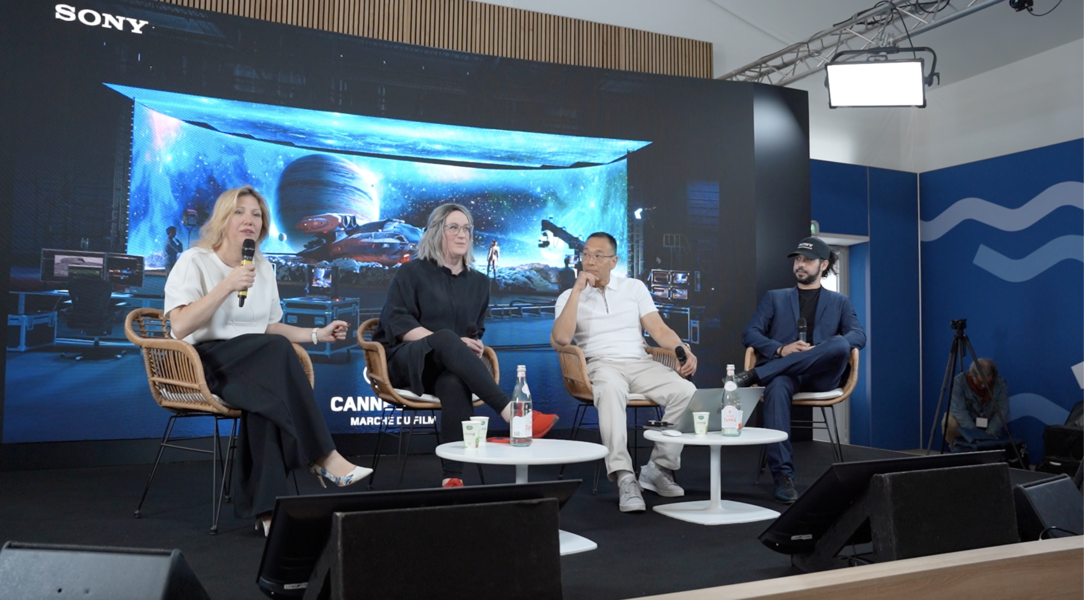
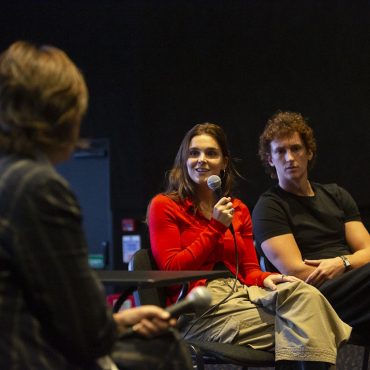
At the Village Innovation of the Marché du Film, during the 79th edition of the Festival de Cannes, a panel devoted to virtual production offered something more revealing than a simple technological showcase. Moderated by Anna Doublet, VP Expert at Sony, and featuring VP supervisors Al Kang and Josh Vigna alongside production designer Jamie Morgan Lapsley, the conversation of “Cannes Next | Visual FX, Production Design, and Virtual Production: A New Trinity for Visual Storytelling | Presented by Sony” moved quickly beyond the usual vocabulary of LED panels, tracking systems, Unreal Engine and camera workflows. What emerged instead was a broader reflection on the changing grammar of filmmaking: not virtual production as a shortcut, not as an all-purpose fix, but as a new creative environment where production design, cinematography, visual effects and direction can once again meet in real time.
Doublet framed the discussion from the beginning with a clear statement of intent. For Sony, indeed, “VP is really the present. It’s not only the future, but it’s the present. A solution to solve problems and also to create something new”.
Emotion and atmosphere through technology
Al Kang opened the conversation shifting the focus away from technical fetishism. Virtual production, he suggested, is too often discussed through its most intimidating components: complex pipelines, real-time rendering, tracking systems, calibration, pixel pitch, refresh rates, colour science. But for Kang, the real point is almost the opposite. The technology matters only if it simplifies the creative act.
He described the blank green screen as an oppressive creative space: “Now imagine that blank sheet of paper 30 feet high and 100 feet wide and colored a garish, garish green. That’s our world”. For filmmakers, actors and designers, the green void has long represented both possibility and alienation. It gives post-production extraordinary freedom, but it also places a psychological and artistic burden on the set. Performers must imagine the world. Directors must trust what is not there. Designers are often forced to postpone decisions. The crew works around absence. Against this, Kang invoked Occam’s razor: the idea that filmmaking should cut through unnecessary complication. “Virtual production is something we will cut through to the chase, get it shot. Because the more we can get in camera, the greater the emotional resonance for both the creators and the audience will be”.
If virtual production is often understood as a digital extension of visual effects. Al Kang argued instead that its power lies in bringing cinema back toward presence: toward a visible world, a shared environment, a space where performers and crew can respond to something tangible. That integration changes the atmosphere of the set, and that’s the only way to ask actors are no longer to perform into a void, but in a space where cinematographers can light against an environment that already exists, designers can see immediately whether physical and virtual elements belong to the same world, and directors can react in the moment.
Production design beyond the physical set
Jamie Morgan Lapsley insisted imstead that virtual production must be understood through the history of production design itself. For him, LED volumes are not a rupture with traditional filmmaking but an extension of older in-camera techniques: forced perspective, painted backings, translights, process work and theatrical staging.
“As a designer, my understanding and my usage of it is intrinsically tied to traditional filmmaking stage technique”, Lapsley said “It’s forced perspective landscapes. It’s painted backings. It’s trans lights. It’s in camera. And the use of it has to be intrinsically a successful extension of that discipline”. This was a crucial reframing. Virtual production is not valuable simply because it is new, but it becomes valuable when it serves the same old problem of cinema: how to make the camera believe in a complex world.
Virtual art, but still art
One of the most revealing exchanges concerned the very phrase “virtual art department” Jamie Morgan Lapsley warned that the word “virtual” can obscure the more important term: art department. “It’s art department first and foremost,” he said. “It’s only virtual once you’ve designed it”. That idea was echoed by Al Kang, who said he fundamentally disagreed with separating the virtual art department from the physical art department. His reasoning was not only philosophical, but practical: art departments already use many of the same digital tools used in virtual production: Rhino, SketchUp, 3ds Max, Unreal Engine. If these assets can travel through one coherent pipeline from conception to final image, iteration becomes faster and cleaner. Less energy is spent translating work from one department to another; more energy is spent refining the creative idea.
Lapsley pushed this even further: early sketches, white card models and rough block-outs can become real-time assets. A crude model can be put on a test panel, explored through AR, or used to help a director and DP understand space before the final build. In one example, he described a physical polystyrene carving scanned and turned into a point cloud, then used as the base geometry for a digital environment. The point was not that the physical model had been replaced by technology, but that the physical and digital processes could now feed each other almost immediately.
Collaboration and the value of early involvement
Josh Vigna, speaking from the perspective of a virtual production supervisor, repeatedly emphasized the importance of early collaboration. The technology can open extraordinary possibilities, but only if the right conversations happen at the script and planning stage. “It starts in that scripting phase”, Vigna said, “and with proper planning, especially having time and schedule to make sure things run effectively, you can come together and create these beautiful, crazy, stunning sets”. Vigna’s contribution avoided the common misconception that virtual production is simply a plug-in solution. “This is a tool” he said “It’s not the answer for everything. It has a specific use case”. For producers and directors, his advice was direct: “Get us involved. The earlier the virtual production team enters the process, the easier it becomes to decide whether a scene belongs on a volume, on location, on a traditional set, or in a hybrid arrangement”.
The metaphor he used was simple and effective: “We are magicians. If the magic act breaks, the audience knows that it’s flawed”.
Blending worlds: where the physical set ends and the digital begins
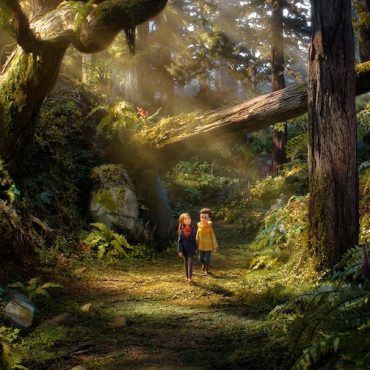
A recurring technical and artistic issue was the gap between physical set and LED wall. Al Kang described the LED screen as a kind of second proscenium space, a new frame inside the cinematic frame that must be overcome if the audience is to enter the world fully. Jamie Morgan Lapsley argued that the most successful uses of LED volumes are the most aggressive in their integration. The ground plane of the physical set must match the ground plane of the virtual world, physical pieces can be scanned and reused as digital building blocks, the edge between set and screen should not be hidden timidly: it should be designed with enough confidence that the camera can move back, see performers full-frame and treat the space as if it were a real location.
He cited examples in which the physical set extended seamlessly into the digital background, making it impossible to tell where one ended and the other began. The ambition, he said, must be exactly that: not to produce a vague, out-of-focus background, but to create a convincing world that can withstand cinematic scrutiny. This point is especially important for the future of virtual production. The medium will not mature if it is used only for safe mid-shots and blurred backgrounds. Its creative potential depends on filmmakers being bold enough to compose, move and stage as if the volume were a location, not a compromise.
Can virtual production still allow accidents?
One of the most interesting questions from the audience concerned randomness. Cinema often finds its greatest images by accident: the sun changes, a cloud passes, an unplanned reflection transforms a shot. Does virtual production risk eliminating that kind of discovery?
Al Kang acknowledged the importance of documentary-style surprise but argued that virtual environments can incorporate forms of randomness: physical simulations, vegetation, traffic, birds, atmospheric effects. More importantly, those elements can be explored during pre-production, while camera positions and dramatic possibilities are still being discovered. Josh Vigna added that virtual production can create a different kind of spontaneity: a daytime scene can become foggier, moodier or closer to magic hour without waiting twelve hours for the sun to change. Mist, light rays, atmospheric elements and environmental adjustments can be introduced live. The accident does not disappear; it moves earlier, into rehearsal, testing and exploration. Jamie Morgan Lapsley offered perhaps the most balanced interpretation: virtual production may not always reproduce the exact surprise of nature, but it can create “more chance to improvise earlier before the clock is ticking on the day”. In other words, the workflow changes the timing of discovery. It invites filmmakers to find gold before the shoot becomes too expensive to experiment.
A new performance space for cinema
From the Cannes Village Innovation, this panel sheds a light on how virtual production is not simply about efficiency, sustainability or spectacle, though it can serve all three. Its deeper promise lies in restoring simultaneity to a filmmaking process that digital post-production has often stretched across departments, time zones and months of deferred decisions. The LED wall hence is not a magic answer, but it requires planning, education, humility and a willingness to rethink departmental boundaries. But when used with discipline and imagination, it can transform the set from a place of absence into a place of shared belief. As Anna Doublet said at the beginning, virtual production is no longer only the future. At Cannes, it looked very much like the present: not a replacement for cinema’s oldest crafts, but a new way of bringing them back into the same room.