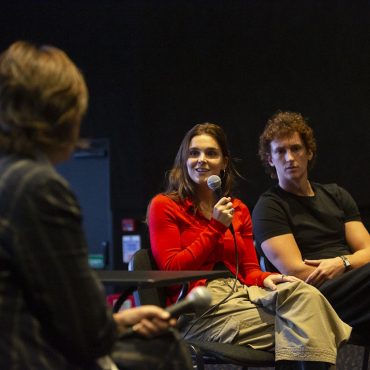
Actors Benoît Magimel and Bastien Bouillon tell us more about Léa Mysius’ “The Birthday Party”, presented in competition at the 79th Cannes 2026 Film Festival 2026. After “Ava” (premiered in the Critics’ Week section in 2017) and “The Five Devils” (Directors’ Fortnight, 2022), for this atypical claustrophobic chamber piece set on a farm that also houses a painter’s studio, the talented French screenwriter-director has assembled a terrific ensemble cast also including Hafsia Herzi in a pivotal role, Monica Bellucci, and Paul Hamy. Our talk with Bouillon, who plays Herzi’s character’s husband, and Magimel, who embodies an ambiguous, scary party-crasher, was as friendly and relaxed as Mysius’ thriller is intense and disturbing.
After evoking the motif of the past coming back to haunt you, a central theme of the film, Benoît Magimel tells us more about how he approached his mysterious character from a screenplay perspective, since he considers the script as ‘living matter’ and wanted, for this character in particular, to understand clearly where he comes from by imagining his back story and what brings him to that birthday party, on that fateful night. “Léa Mysius and I reworked the screenplay, because it seemed important to me to say more about his past with this woman, to bring in more context, and above all I wanted to talk about the prison environment and about what confinement can do to a man, how much it can damage him. And I also wanted to tell that story to this child, because he can’t just turn up thinking he will be able to build a relationship with her like this, so he had to speak his truth, and lay himself bare. That seemed important to me, but initially, it wasn’t really present in the script”.
On the question of what each of them tends to look at first in a screenplay, Bastien Bouillon (whose breakout film was the mindblowing “The Night of the 12th” by Dominik Moll) says, “First off, it’s not my own part, it’s something more general. It’s the project I feel I can see in there, maybe understand a little – because of course, you never know what it’s going to become, what the final film will be like exactly. Then there’s also the human factor, but in any case [I always consider the project in its] entirety”. The actor relies heavily on his instincts. “I couldn’t put it in words, but there are places where I won’t go”. He clarifies by mentioning projects ‘claiming to be political’, when it’s really just posturing.
For Benoît Magimel, “what really counts is first and foremost the director, to the point that sometimes, the screenplay becomes very secondary. I also like discovering things, I like characters that have contradictions – that’s what I really enjoy, above all. And the issues at stake. And yes, the human aspect, possibly a sense of urgency, etc”. The seasoned thespian – crowned Best Actor in Cannes back in 2001, for his performance in Michael Haneke’s “The Piano Teacher”, very impressive in the more recent “Pacifiction“, by Albert Serra, and “The Taste of Things” by Trần Anh Hùng, which both competed in Cannes, where Magimel is showing, this year, not only Léa Mysius’s film but also Antonin Baudry’s “La Bataille De Gaulle : L’Âge de fer” in the Out of Competition strand – adds that he likes to feel ‘like I’m taking a risk, like I have something to defend’.
We talk at length about the complexity of all the characters in “The Birthday Party”, and about the importance of the backstory
“Léa, Bouillon explains, has the great quality – in all her films, and in this one in particular – of never creating a single role that doesn’t have a soul. On set, I found her very present at all times, to remind me of that soul and of what’s moving in the scene at hand. She gives you space while also being very precise, and indeed, as Benoît put it very well when he was talking about the characters’ backgrounds, in this film, everything needed to feel loaded. I think that this is also why Léa managed so well to make the viewer feel like time is expanding, in certain scenes, whereas with this type of claustrophobic chamber piece, one may be tempted to favour efficiency”.
Our conversation also addresses the inevitable surprises in store for the actors on the set of such a ensemble ‘drama behind closed doors’ bringing together such a fine group, each gifted with a role with real depth, especially one that revolves around a surprise party and throughout which the audience never knows who is who, what is going to happen, how much is planned and how much is slipping out of control.
Plot
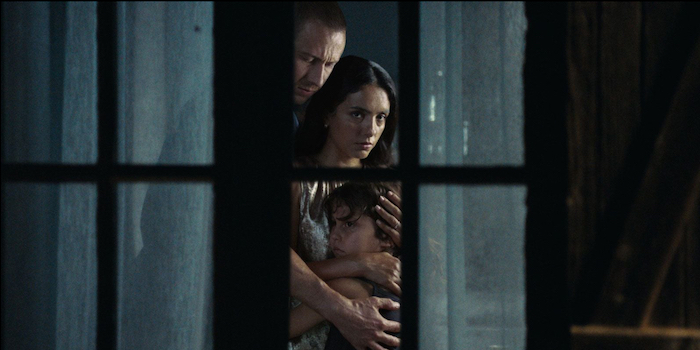
Thomas, Nora and their teenage daughter Ida live on remote marshland. Social contact is limited, as they only have one neighbour, Cristina, an Italian painter. As the two households plan a surprise birthday party for Nora, strange disturbances begin to occur and unease rolls over the marsh.