During the 24th edition of Alice nella Città, in Rome, we spoke with character designer Thibault Leclercq for the film Wildwood, e mesmerizing tale of adventure and discovery that uses the stop-motion animation technique with a bigger scale than ever. The film adapts a novel by Colin Meloy enriched by his wife Carson Ellis’ illustrations, which provided a distinctive starting point also for the character designs of the film. Leclercq describes indeed how the team sought to honour that visual identity while shaping characters for a feature film with a more mature tone, also revealing how Portland’s landscape and the practical demands of puppetry helped in creating the film’s blend of naturalism and fantasy.
The interview
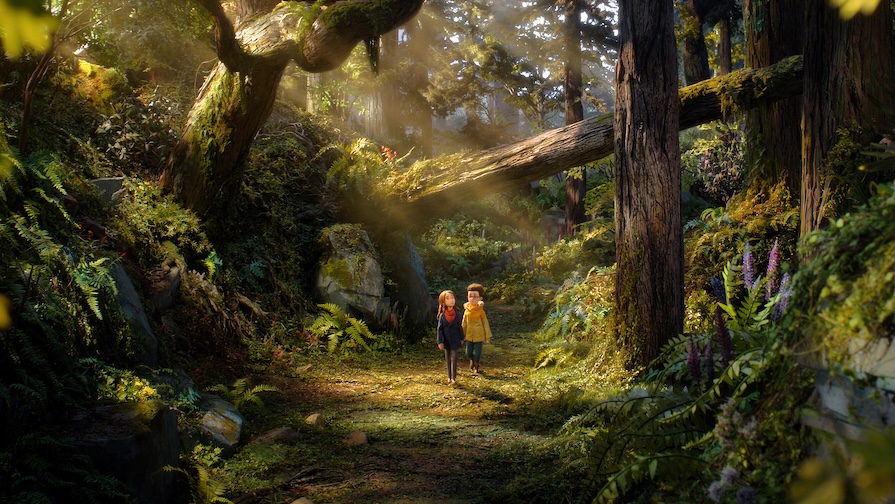
During our interview on FRED Film Radio, Leclercq stated that the Wildwood design process began with a commitment to retain the charm and illustrative quality associated with Ellis’s work. That influence appears in the puppets’ fine details, from their hair and anatomical features to the patterns on their costumes. The designs also preserve a simplicity in their silhouettes, keeping a connection to the source material without reproducing it unchanged. At the same time, Leclercq aimed to give the characters greater sophistication, suited to a story that moves between wonder, hardship and darkness.
The narrative strenght of Wildwood also lays in its relationship with the natural world shaped the visual approach, character designer Thibault Leclercq also explains. Rather than relying on obvious symbols, the designer team drew on organic forms, subtle curves and asymmetry, allowing small irregularities to make the characters feel connected to nature. His own experience of moving to Portland to work on the film offered a close view of how residents relate to the surrounding woods and landscape. Observing local habits and ways of dressing helped him develop a more grounded sense of the world the characters inhabit.
Also the animal characters required a balance between expressive movement and believable animal behaviour. What Leclercq said to FRED Film Radio is that the Wildwood design team worked alongside the puppet team to make the creatures convincing, including coyotes that move upright despite being naturally four-legged. The “Napoleonic” costumes of some of the characters also add an intentionally unsettling quality, while the characters remain recognisably animals rather than humans concealed by animal disguises. A balance of fantastic and realistic, among many other incredible aspects, that makes Wildwood in of the most astonishing examples of stop-motion animation of our times.
Plot
From the visionary creators of Coraline, Wildwood is LAIKA’s latest stop-motion adventure. When Prue’s little brother is kidnapped by a flock of crows and taken beyond the city limits, she sets out to venture into the impenetrable forest on the outskirts of Portland. Together with her friend Curtis, Prue finds herself thrust into a hidden world inhabited by extraordinary creatures and dark forces threatening its delicate balance. What begins as a rescue mission soon becomes a journey of self-discovery and courage, as Prue forges unexpected alliances and discovers the unique role she must play in shaping the fate of Wildwood.
A dark fairy tale about growing up, belonging and the fear of being replaced. Bàrbara Farré and Diego Betancor discuss the personal origins of Mala Bèstia, its unsettling vision of adolescence and the decision to make a debut feature without …
Ben Watkins, Jaalen Best and Giovanni Ribisi on The Greatest, the Prime Video series that tells Muhammad Ali's story as a coming of age, before the icon and the legend.