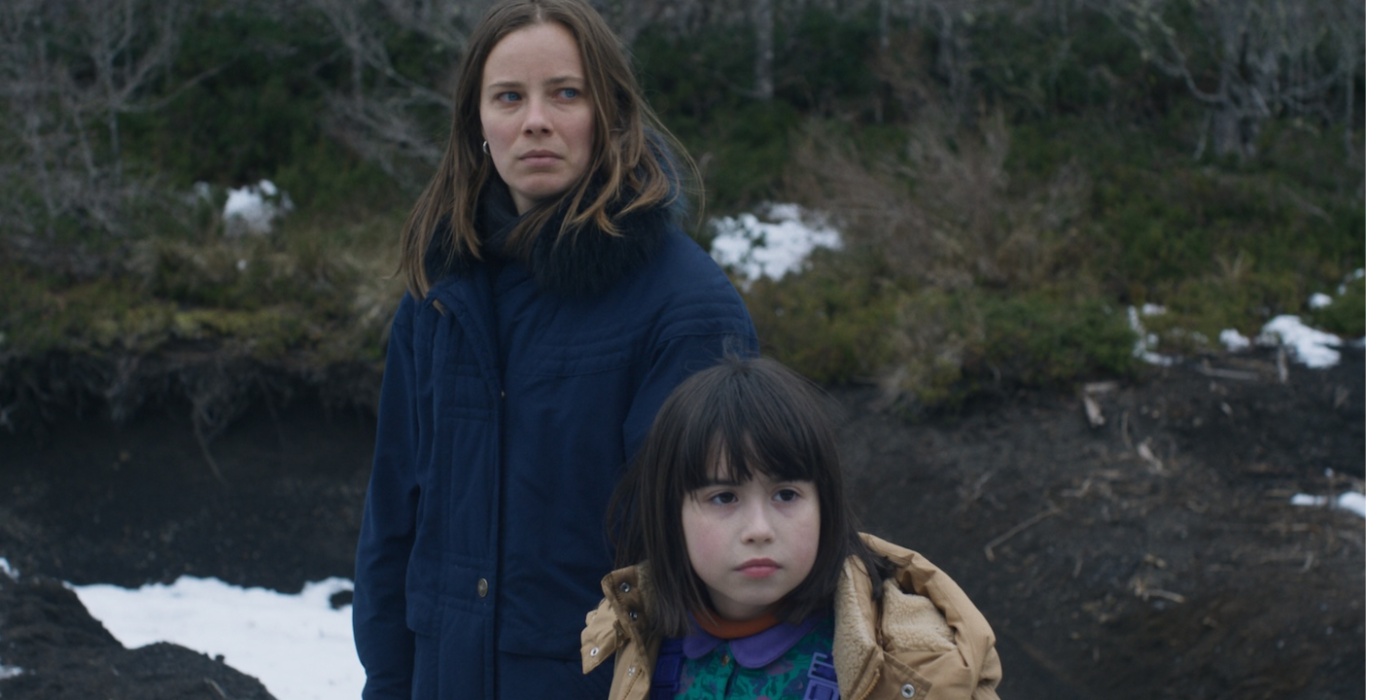
Screening in Un Certain Regard at the 2026 Cannes Film Festival, “The Meltdown“ is the new film by Chilean director Manuela Martelli. Set in 1992, it follows nine-year-old Inés during a stay at her grandparents’ remote hotel near an Andean ski resort, where she befriends Hanna, a fifteen-year-old German skier, that suddenly disappear without explanation. Manuela Martelli is back in Cannes after premiering her first feature film, 1976, at the Cannes Directors’ Fortnight in 2022.
Unlearning what we take for granted
The film’s starting point was a short story, something small that grew into a meditation on childhood as a space for questioning. Manuela Martelli was interested in the child’s gaze precisely because it has not yet learned to accept things as fixed such as class hierarchies, social silences, the idea that some things are simply “natural.” The class issue in Chile, she explains, is one of those blind spots: “the idea that it is ‘natural’ to sit at a table while another person stands. Not questioning that is one of the triggers for how I look into things”.
Two countries that no longer exist
Saskia Rosendahl came to the project with a particular kind of personal resonance. Her family is from the GDR (East Germany), a country that, like the Chile of Pinochet’s aftermath, belongs to a geography of memory more than to any current map. Preparing for the role, she read a book on GDR history with her grandmother, and found that the two histories kept speaking to each other: “I got to know my own background more through the connection with Chilean history”. Playing a foreign woman stranded in an unfamiliar country, unable to speak the language, abandoned by authorities, it was, for her, less an exercise in distance than a return to something close.
A victim of silence
The film’s most quietly devastating passages involve the way institutions dismiss a woman who does not know the language, does not know the rules, and cannot fight what she cannot name. Saskia Rosendahl describes her character as “a victim of silence, facing a wall you cannot fight alone without others helping you” . Manuela Martelli did not set out to make the patriarchal system explicit but it surfaced on its own, both on the page and on set, where she found herself having to defend her vision with a persistence she recognized as gendered: “I felt how much more you have to defend what you think compared to a man”.
Keeping memory alive
Chile in 1992 is a country just beginning to reckon with what happened under the dictatorship and “The Meltdown” moves through that reckoning carefully, without claiming to remember correctly. For Manuela Martelli, there is no correct memory, only the responsibility not to let it disappear: “we must keep memory alive, society forgets so easily”. The parallel with the present is not incidental.
Plot
Chile, 1992. Staying at her grandparents’ remote hotel near an Andean ski resort, Inés (9) befriends Hanna (15), a German skier. When Hanna vanishes without a trace, the search for her exposes hidden truths.