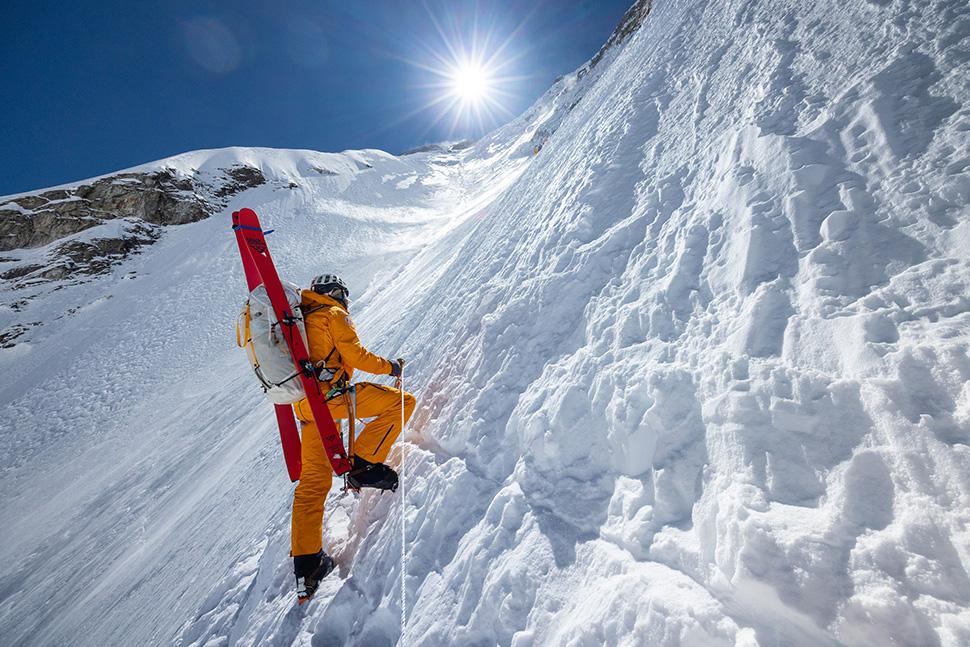
Presented out of competition, in the Venice Open section of the 83rd Venice International Film Festival, Everest: The Other Side follows elite ski mountaineers Jim Morrison and Hilaree Nelson, who fell in love while reaching the pinnacle of their sport and set out to climb and ski Everest’s direct North Face, the most dangerous climb on the mountain and the most coveted ski line on earth. Co-director Elizabeth Chai Vasarhelyi, who previously won an Academy Award with Free Solo, talks about making a film shaped by grief after Nelson’s death, the physical challenge of filmmaking at 29,000 feet, and what she has learned since Free Solo.
“The worst thing happened on this film”
Asked which of the film’s two challenges, technical or emotional, weighed more, Vasarhelyi answers without hesitation: “As I say in the film, really the worst thing happened on this film, and Hillary was a dear friend of all of ours, and we set out to make this film because of Hillary and Jim.” What drew her to the story in the first place, she explains, was Nelson’s own honesty about an impossible balance: “She was singular in her ability to be candid about, you know, it’s a mountain, it may not matter very much, but it’s everything to her, and that she was also a very committed mother, but there was no way to balance it. There’s no rational way of balancing it. And that I found very interesting, and enough to make a film about.” The project, she says, changed shape entirely along the way: “The film evolved, the story evolved. It was tragic when she passed.”
Making a movie at 29,000 feet
Beyond the emotional weight of the story, Vasarhelyi describes the sheer physical logistics of the shoot: “Making any movie is a miracle, right? Try making a movie at 29,000 feet, okay, where you can’t put any helicopter up there. Everything gets up there by human effort, you have to just put one foot in front of the other carrying pounds and pounds of stuff. And if you forget your lens, what are you going to do? If you forget to wash the cloth to clean the lens, there’s no Amazon.” That isolation, she adds, extends to the whole crew: “It’s also requiring our crews to be away from their families for two months at a time. So it’s extreme. But I just want everyone to remember: making any movie is really really hard. Just imagine 29,000 feet, making that movie with the same challenges.”
The audacity to dream, and the diligence to see it through
Asked how to explain a passion that pulls people away from their families for months at a time, Vasarhelyi compares it to any other calling, and quotes Nelson herself: “I actually think their passion for mountaineering is not dissimilar from artists’ passions or filmmakers’ passions. I think Hillary really says it the best, that it’s like a dog with a bone. She has to do it, and once she starts thinking about an objective, she starts dreaming about it. She knows it’ll happen.” For Morrison, she says, that same drive became a way through loss: “Jim really had to work incredibly hard to find a way to move through his grief and let that grief inform a life of intention.” Asked what she has carried from Free Solo into this film, Vasarhelyi points to something more fundamental than any technical lesson: “With Meru, you really shouldn’t do this, but it’s okay if you’re with your best friend. With Free Solo, you really should not do this, but it’s okay if you’ve thought really deeply about it. This one was like, this is a terrible idea, and they did it. I think it’s just this fundamental human condition where you have this audacity to dream, and also the kind of crazy diligence and grit to actually see it through.”
Plot
Elite ski mountaineers Jim Morrison and Hilaree Nelson fell in love while reaching the pinnacle of their sport. Their drive sharpened into a shared dream: to climb and ski Everest’s direct North Face – the most dangerous climb on the mountain and the most coveted ski line on earth. Thousands have summited via Nepal’s southeast ridge, but only a handful have reached the top by this route, and no one has ever skied down.