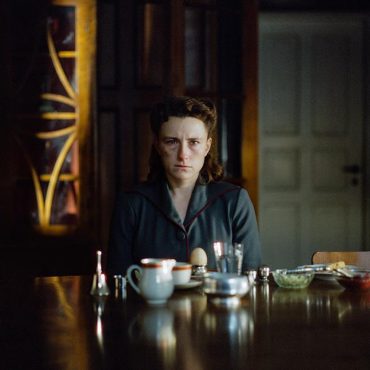
After “I Have Electric Dreams”, which collected three Leopards at Locarno 2022, for best direction, best actress (Daniela Marín Navarro), and best actor (Reinaldo Amien Gutiérrez), Costa Rican-French director Valentina Maurel has just shown her second feature film, “Forever Your Maternal Animal”, in the Un Certain Regard section of the 79th Cannes Film Festival, which owed the three protagonists of the film (Marina De Tavira, Daniela Marín Navarro, Mariangel Villegas) a joint Un Certain Regard Prize for Best Actress.
On the fact that “Forever Your Maternal Animal” somewhat expands on what she did in her debut, featuring a similar set of characters played by the same actors, Valentina Maurel explains: ‘Of course I always talk about family relationships, because for me it is the place where you know yourself the less… because you build yourself a life, you try to control something of your life, and then when you go back to the country you come from or to your family, there’s always something completely strange – you’re caught up in dynamics that are completely blurry...’ ‘This time,’ she adds, ‘I wanted [to pair that subject] with the fact that when you are a Latin-American person who lives in Europe, you also feel very estranged from your own country because you easily start believing that Europe is actually the centre of the world – even if you don’t want to, but this is the sensation you have, and that your own country is a very peripheral place in the world. That, and you also feel estranged in your own family.’
On the fact that the film is not linear and that the viewer, not quite knowing what it is going to be about, happily let’s him- or herself be immersed in the urban environment of San José (in the neighbourhood where the director was raised) and the somewhat haphazard criss-crossing trajectories of the members of this disconcerted family where each one is going through a bit of an existential crisis: ‘I like that kind of structure, because it feels like life – you just go through it and you don’t really know where it’s gonna take you. And then at some moments of your life, you can grasp [a hint of meaning], but then you forget about it and you go through life again...’ Maurel also points out that everything is determined by the characters: ‘I think characters are enough, sometimes, to make a film.’
On the title, borrowed on a whim from one of her own mother’s poems, Valentina Maurel confesses: ‘I felt like this title had a secret meaning for me, and now when I see the film, I realise the title has a secret relation with the film which is not obvious, but important.’ She adds: ‘I can never find titles for my films. I used to think it was a problem, but now I think it’s okay: you cannot explain my films through a title. It’s difficult to pitch, but I think I like that.’ ‘“Forever your maternal animal” means, she continues, that no matter what happens, I will be your mother, and that’s beautiful and comforting, but I think it also feels almost like a threat – a threat to the daughter, who doesn’t want to have her mother forever attached to her life, or maybe a threat to oneself as a mother: you don’t wanna be forever a mother… Motherhood has something that is imprisoning for the one who has to carry this responsibility but also for the one who has to be the object of this responsibility… So I wanted to talk about these things without [formulating] a definitive message.’
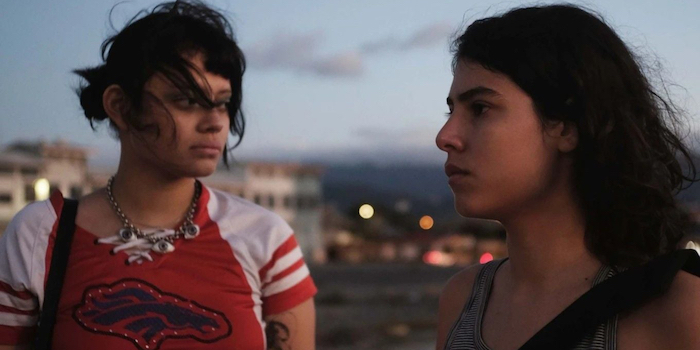
On the character of the little sister, Amalia, and her brand of rebellion: ‘[She’s] a character who wants to escape the certainties her sister has about what is good in life – in the same way you want to escape your mother’s certainties –, but also the success model of a certain intellectual middle class that thinks that if you want to succeed in life, you have to study, that you can believe in God or the illuminati but not both, because these things are contradictory, and I think this also represents also a way of thinking that Elsa has, because she studied in Europe and because she is very far from what is also a Latin American culture that negotiates with reality in more flexible way. [Latin America] is a very religious place – like Europe, indeed, but it’s a religion of a softer kind, which hasn’t been contaminated by secular things and allows itself more manifestations of spirituality, of the unreal … Amalia wants her freedom, and her freedom is to go in the opposite direction of where a bourgeois education wants her to go.’
Plot
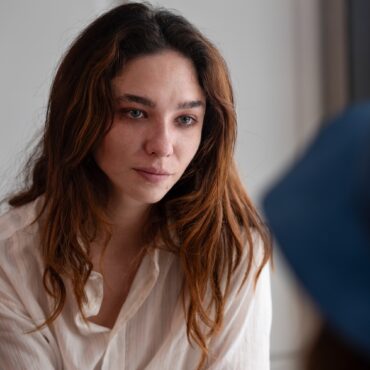
After years studying in Europe, Elsa returns to Costa Rica to reunite with her family. She finds her younger sister living alone in the family home, growing increasingly distant and reclusive, as if slipping into a world of her own. Their parents, meanwhile, are absorbed in their own lives. Her father drifts through a series of affairs, while her mother is immersed in republishing the erotic poems of her youth, neither fully grasping the urgency of the situation. Elsa’s return draws the three women into a confrontation with what still binds them, despite everything.