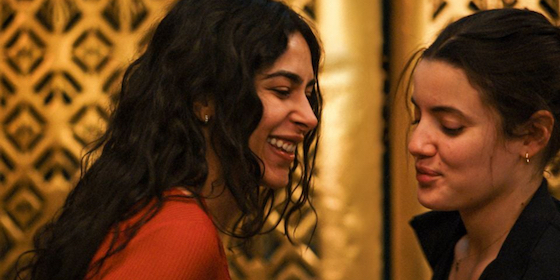
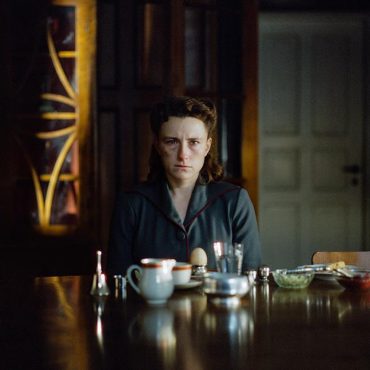
Hélène Rosselet-Ruiz, already noted for her short films, is one of the contenders for the Caméra d’Or with “Madame”, screened at the 79th Cannes Film Festival as part of the Special Screenings. To discuss this fascinating chamber piece co-written with Pauline Guéna (author of the story behind Dominik Moll’s excellent “The Night of the 12th”) which unfolds (almost) entirely in a private mansion located in the so-called “Golden Triangle”, the most luxurious area in Paris. The French director is joined by her actress Malou Khebizi, who plays Laura, the tough factotum who looks after Souria (played by Soundos Mosbah), the mistress of the Saudi sheikh who lives shut away in this house, in “obscene” luxury (to use the director’s own word) but under surveillance, with only Laura and a man, Emre (Ziad Bakri), for company. The actress tells us more about how she related to the character and approached her complexity.
Hélène Rosselet-Ruiz explains that she experienced the unusual situation of Laura’s character firsthand and actually entered this world we typically never see, after which she carried out extensive research, into the world of servicing luxury clients on one side, and also on cases of Saudi (and other) women who fled such situations, also drawing on the work of sociologist Alizée Delpierre and journalist Hélène Coutard.
Asked about the opposition or symmetry between the characters of Laura and Souria, the director specifies: “What really infused all the writing and the construction of the two characters, these two relationships to being a woman, is the confrontation of two femininities that are pitted against each other but eventually, in both cases, deemed never enough. That is to say, whether you’re a woman who refuses to endorse the trappings of femininity (for example who is into being strong and grounded, as is the case with Laura’s character) or a woman who ‘performs’ a certain hyper-femininity (thus taking on the idea of somehow wearing a mask), well, in both cases, it’s never enough, it’s never right… And I can say I have been both, so I was interested in setting these two face to face, because I think the line is thin between these two ways of ‘performing’ one’s condition.”
As for the character of Souria, and what leads her to accept these living conditions, Hélène Rosselet-Ruiz comments: “I wanted us to discover her little by little, for her not to be a character reduced to the stereotype she invokes. As women, we often accept living conditions, even relationships, that don’t suit us, in the sense that I’ve frequently found myself in situations where as a woman, I’d say to myself, ‘theoretically, I don’t agree with what I’m experiencing, and I don’t think it’s normal.’ And yet, that doesn’t prevent you from accepting these situations… As women, we regularly find ourselves in situations we could question, and yet we are also rooted in them, and it’s an entire journey we have to undertake, a collective journey as women. We need to… break free from these patterns, and having a character like Souria, who is aware of what she’s accepting, and in exchange for what, that interested me.”
Plot
To make ends meet, Laura takes a job working for Souria in a grand mansion in Paris’s Golden Triangle.
Installed there by her lover, a wealthy Saudi prince, Souria lives in anticipation of his visits. As Laura struggles to adjust to this world of excessive luxury and constant surveillance, a fragile bond begins to form between the two women. But Laura senses that Souria is in danger, and that this gilded cage may be closing in on them both.