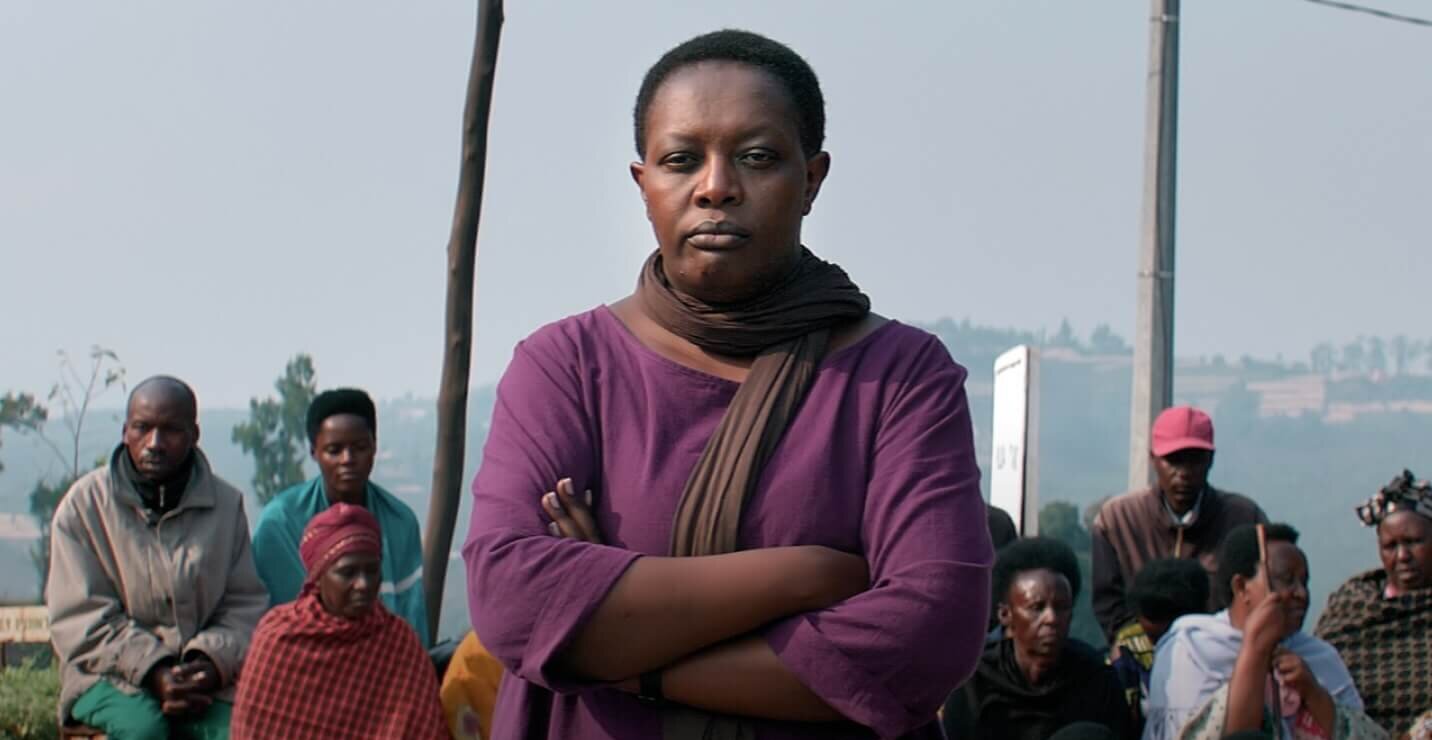
Fresh from winning the Caméra d’Or and the FIPRESCI prize for Un Certain Regard at Cannes 2026, where it was the first film by a Rwandan director to enter the Official Selection, Ben’Imana, the debut feature by Marie-Clémentine Dusabejambo, is in competition at the 23rd Marrakech International Film Festival. Set in Rwanda in 2012, the film follows Vénéranda, a genocide survivor who leads dialogue between victims and the families of perpetrators, until her daughter’s unexpected pregnancy tests her own convictions. Marie-Clémentine Dusabejambo talks about the personal journey behind a film thirteen years in the making, her choice of fiction over documentary, women as a metaphor for a country’s rebirth, and the language of silence.
Going back to the source
For Marie-Clémentine Dusabejambo, who worked on Ben’Imana for thirteen years, the starting point was deeply personal: “The starting point for me was to understand myself, to understand what happened. This film, when it started, looked for me as going back to the source.” Her first short film had already dealt with the subject: “The first short film I did was on the journey of reconciliation with the arena of the Gacaca court, the popular court that was set in Rwanda to judge the crimes of the genocide against the Tutsis.” Growing up in the aftermath of the genocide, she explains, meant growing up surrounded by silence: “There were so many things going on with the generation of our parents. So I didn’t really know the depth of living in the aftermath of the genocide, the cost to pay for the people to live together again. And so in that short film I didn’t go deeper. And with this one I said, ‘Okay, let me take a subject that also speaks for me, that is going to feed me and open my eyes to where I come from, who I come from,’ because this is an identity we share, all Rwandans, and every generation will relate to it.” She adds: “Every generation will have their own battles. It will be up to us to know how to fight them with dignity. It was mostly trying to find my place into my community.”
Why fiction over documentary
Marie-Clémentine Dusabejambo initially considered making a documentary, driven by a need for authenticity: “All I wanted was to be authentic, authentic to the history, as this is about real people, real stories, real suffering, and people were still suffering, especially emotionally. It’s their wounds that you can’t see with the eyes, but you can feel them, you can capture them.” Her experience working on other filmmakers’ documentaries changed her mind: “During my research time I would have intimate moments and depth from the people, and then the moment the camera was set, those moments couldn’t be recreated. So that’s why I chose to go for fiction.”
The womb of a country
Placing women at the center of the story wasn’t part of the original plan, the director admits, but it became the film’s core metaphor: “Women represent so much more than what we see as bodies, it’s a metaphor of conceiving, going through that process, and then birthing. There’s a lot of wombs: there’s the womb of a country, there’s the womb of generations, there’s the womb of a language, of a culture. And what is the seed in those wombs? This is what produces what we see in our communities, how we see our children becoming.” That’s why the therapy room where her characters meet is, for her, a place of repair: “When these women were sitting in the therapy room, they came together, either from the victim’s side or from the perpetrator’s side, they came to repair. So when we talk about reparation for a society, what do we repair? That is the most crucial question. We have to think of ourselves as the womb of a country: how is a country rebirthed? And a wounded mother, of course, is going to wound her children.”
A silence that speaks
The silence of her parents’ generation, Marie-Clémentine Dusabejambo explains, was not an absence but a choice made for the future: “A silence that speaks: ‘What I suffer, I don’t want it to cross over to another generation. I just want to speak hope. I want to have this hard conversation with the mother of the killers of my children, not because I’m not suffering, but because I’m thinking of the future.’ And this requires a sacrifice of just letting go, letting go of the pain. Even though the womb is bleeding with unforgiveness and resentment, let’s try to sit and weave again that womb.” The same idea shaped her balance between what is said and what is left unspoken on screen: “There’s a language of silence, and the language of silence speaks better than the language of words. I would choose not to utter a word and choose to keep it silent, and this doesn’t mean I didn’t express myself. Actually, this is what the grandmother is embodying: she’s there, she’s looking, she’s seeing, she’s feeling, it doesn’t mean that she’s not communicating.”
Plot
Rwanda, 2012. In the years following the Genocide against the Tutsi, community-led trials for justice and reconciliation continue across the country. Vénéranda, a survivor, leads dialogue between victims and the families of perpetrators, helping others rebuild their lives and look towards the future. But when she learns of her daughter’s unexpected pregnancy, she is forced to confront the limits of her own convictions.