This year at the Karlovy Vary Film Festival 2026, not only was Ivan Ostrochovský selected in the main competition with Only Beautiful Things to Look At, his third fiction feature after Goat (2015) and Servants (2020, chosen as the Slovak candidate for the Oscars), but he also world-premiered, amongst the Special screenings of the Classics section, his new documentary, Igor and After, dedicated to visionary Czechoslovak cinematographer Igor Luther (who worked with Juraj Jakubisko, Volker Schlöndorff on his Palme d’or winner The Tin Drum, and Andrzej Wajda on Danton, amongst others).
He also produced the winner of the Special Mention of the Proxima Competition, Anna and Šimon Domček’s 33 Steps.
Only Beautiful Things to Look At, the suggestive title of which is all the more intriguing that the film deals with the State-funded sterilisation of Roma women in Czechoslovakia in the 1980s, ended up earning Ostrochovský the FIPRESCI Award of the Crystal Globe Competition.
This bodes well for the US remake of the film (focusing on the forced sterilisation of almost half of the Native American women which was conducted across the pond between the 1970s and the 1980s) he has already started working on, with the help of his regular producer Katarína Tomková.
FRED met with her and the prolific filmmaker on a balcony of the famous Thermal Hotel to discuss the very unique angle he chose, in his KVIFF critics’ favourite, to tackle a sordid issue through images and situations often beaming with serene harmony and human connection.
A doctor who sees sterilisation as compassion
On the choice of approaching the subject of enforced sterilisation through the eyes of a female doctor who sees sterilisation as a compassionate procedure: “I met a lot of doctors from the 80s, and the problem is that some of them really thought it was helpful to these Roma women, that having three kids instead of ten would make their lives easier. […] So the law says yes, and in context, it seems okay, but morally it’s not, and this is a problem for all times, not only the communist era.”
“There was forced sterilisation in the US, in Norway, in Australia, in Canada: it’s not limited to the eighties in Czechoslovakia, it has also happened in democratic countries. […] This is also related to the desire to have a nice, comfortable life. These doctors think that if you only have two kids, you life will be easier: you can go on vacation, have a car. [This notion] of a nice life is how you end up having sterilisation.”
Ingrid and Agata: the bond between doctor and victim
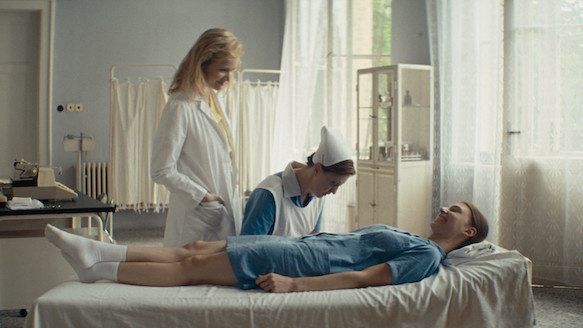
On the bond which develops between Ingrid, the doctor played by Aňa Geislerová, and Agata, the Roma nurse who tries to hide her origins, and on the complexity of both characters, Ostrochovský says that he found interesting to understand how the doctor thinks, but also wanted to find a way to make her change and see things differently, which he did by introducing this young girl who is a victim, ie. using the victim to confront the person responsible.
Casting Simona Boledovičová as Agata
On the choice of Simona Boledovičová to play Agata: “She had never played in a movie. It took a lot of time to find her, also because we wanted her to be half Roma – so many films with gypsies have been made before that [if you work from a set of stereotypes] about gypsies, you’re not interesting.”
“Also, if it [forced sterilisation] happens to a woman who is only half Roma, it’s a short way away from happening to Slovak women with social problems […] and the idea of cleaning social problems in this manner. [If you show] it as a problem which affects not only gypsies, but also poor people, our hope is that in this way, we can get under the skin of people holding stereotypes.”
Beauty hiding darkness: the film’s visual approach
On the beautiful, serene aesthetics of this superbly lit and sunny film, interspersed with oneiric scenes showing an almost magical nature as well as moments of tenderness and laughter: “The topic is already tough, so we did not want to push it further visually. We wanted to find nice places, since these people want a nice life for the gypsies, and so visually we wanted [everything to be beautiful] and then to have [darker] things hiding in these nice visuals, and then slowly amp it up.”
“Because if the film is nice visually and thus goes against the topic, maybe it is more scary than if you show an ugly socialist hospital and ugly places and bad cars. Visually, [we wanted to represent] Ingrid’s idea of a nice life – she wants a nice life for everybody, and she destroys many lives.”
Shooting across three countries and three summers
Katarína Tomková on the challenges of the production of a film with such rich visuals and interesting locations: “It was a bit challenging because for example when it came to the architecture, we were looking, not for the typical communist architecture, but for a turn-of-the-century architecture which I would call Habsburg, from the end of the imperial era – buildings which of course, in the 80s, were a little bit rundown –, because these buildings do exist, but now they have been reconstructed, they have plastic windows, etc.”
“So it was tough to find this one complex place in one location. The hospital, I think, was shot in six or seven different locations spread around the Czech Republic, Slovakia and Hungary. […] But Ivan had a specific idea of the visual aspect he wanted.”
“[…] So in those terms, yes it was a little bit challenging to have the production happen across three countries, with crew from three countries and cast from three countries, and also we shot across three summers – which had a lot to do with filming [the doc] Photophobia the first summer, because the film was reacting to the situation in Ukraine.”
“But I think that we had an amazing cast and crew, and our partners and coproducers all understood and followed Ivan’s vision, so I feel like we all formed a coherent team, which eventually got us to this wonderful premiere here in Karlovy Vary.”
Plot
The film is set in the mid-1980s, when the state used its laws to continually influence the most intimate facets of its citizens’ lives. Ingrid (Aňa Geislerová) is an ambitious doctor, whose mission is to bring children into the world, to terminate unwanted pregnancies, and to participate in the sterilisation of Romany women. The melancholy woman has greater misgivings about her private situation than she does about her professional life, that is, until she is caught “off guard” by a new friendship with a charismatic Romany orderly. Spontaneous Agáta presents to Ingrid the human contours of a national minority reduced by the communists to a demographic problem. Ostrochovský’s beguiling drama returns to a hitherto unresolved issue of Czechoslovak history, where the option of having children was determined by the state.