In Italian cinemas from October 1, distributed by MUBI, Her Private Hell is Nicolas Winding Refn‘s first feature in ten years, since The Neon Demon.
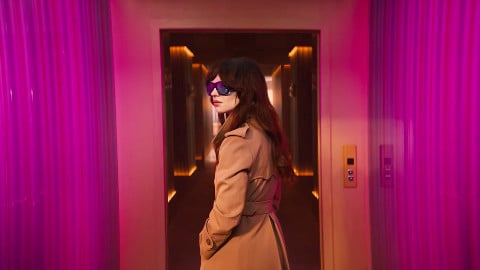
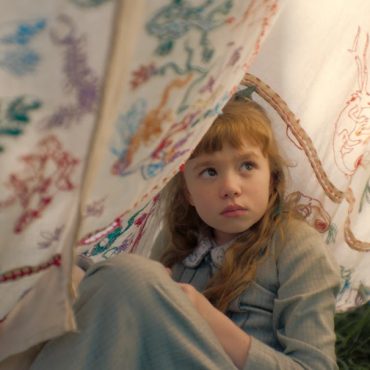
Set in a surreal, futuristic metropolis shrouded in pink mist, the film follows Elle (Sophie Thatcher), a rising movie star preparing to shoot a space odyssey alongside her ex-lover turned stepmother (Havana Rose Liu), while elsewhere in the haze an American GI (Charles Melton) wanders the desolate streets in a desperate search for his daughter. As a sinister figure known only as the Leather Man stalks the city’s shadows, their lives begin to converge, dissolving the boundaries between past and present, memory and fate.
The director talks about blending many genres into a single film, the father-daughter relationship at its core, his collaboration with composer Pino Donaggio, and the near-death experience that brought him back to cinema after years spent in the world of streaming.
Many movies in one
For Refn, the starting point was the idea that genres no longer need to be kept apart: “I wanted to make a movie that was sci-fi, thriller, horror, camp, comedy, symbolism, opera, melodrama, but all in one. So, suddenly everything became elements”. He traces that impulse back to a childhood memory: “I remembered when I first came to America, when I was 8 years old, and I discovered television and the idea that I could click channels. That was so new to me, that on every channel there would be something else. So it’s what you would do in scrolling today, and I would be very addicted to this constant movement of my hands between the channels”. Going back to filmmaking, he explains, meant a clean break: “I wanted to get away from my past and to completely re-envision what I think cinema of the future is. And obviously that became Her Private Hell”.
A father-daughter story, reverse engineered
At the heart of the film is the bond between fathers and daughters, which Refn describes as “a very complex theme, because having two daughters, it’s very complex”. He wanted to overturn a genre convention he finds peculiar: “Most films of genre are about violent men doing violence to save their children and justifying extreme violence. And I found that very peculiar, because it was almost like pornography for men. It’s a very male kind of fetish and fantasy”. So he flipped the perspective: “I thought it could be interesting to reverse engineer it, that it’s about a daughter whose father is taken away from her by her lover. So you have a pretty dramatic triangle, and then she creates an alter ego, which is the perfect father that would go to hell to bring back his daughter, which is something we all would want to be as men”. Refn sees the film as a companion piece to Only God Forgives, “which is very much about a mother and son relationship and the incestuous component of the mother species devouring her children”.
An opera by Pino Donaggio
Unlike his previous projects, Refn had no idea at first what the film should sound like: “I usually have a musical idea very early in the stages of a film or the shows I make. But with Her Private Hell, I didn’t have any idea what the film was going to sound like, because there were so many elements combined. And it was a bit frustrating”. The answer came during the shoot: “About halfway through the production, I realized that what I really wanted to make was an opera. And I said, ‘Okay, it’s an opera. At least I know what that sounds like’”.
That led him to Pino Donaggio, whose music had been with him for a long time: “Like the last 20 years I’ve used Pino’s music as a kind of source, and I realized that he was still alive. So I reached out to him, and he was young at heart even though he was an older gentleman”. Refn set only one condition: “That you turn it into an opera, because all these pieces had to be tied together. Something had to connect all these various ideas that I couldn’t and I wouldn’t change, and that would be the music. So what would tie everything like a bow would be Pino’s music”.
Ten years in the rabbit hole of streaming
Explaining the long gap since his last feature, Refn recalls being at Cannes with Only God Forgives just as Netflix was launching its original shows: “I could see right away, in my opinion, that this was going to change everything”. After The Neon Demon, he says, “I’d kind of come to the end of what I really wanted to do with movies, and then I went into the world of streaming, or let me put it like this, I fell into the rabbit hole of streaming”.
He made a show for Amazon and Copenhagen Cowboy for Netflix, both of which he enjoyed making, unlike the streaming environment itself, while a planned HBO show, Maniac Cop, never happened. Then came a collaboration with Prada and the half-hour film Touch of Crude: “It was the first time I made anything that had no desire to be commercial. It was like painting a white wall blue, and it was never going to be as good as that again. So why continue?”
Dead for 20 minutes, and a second chance
“And then I died”, Refn says plainly. “When I was dead for 20 minutes and came back, it was almost like God gave me a second chance, and I realized that I want to go back and start over again, and that is cinema”. By then, he says, streaming had turned into “more generic algorithmic content”: “It’s a very functioning mechanism, but I don’t find it particularly interesting, because I don’t think the algorithm is very healthy for the human soul. It just consumes your time. But trust me, being dead, you come back, you realize how valuable time is”.
Between Her Private Hell and the exhibitions created with Prada in Tokyo and New York, cinema is now, for him, part of something larger: “For me, cinema is no longer one thing, it’s part of many things. So one idea which used to be cinema is now an opportunity to create multiple avenues of the same idea because of technology. And I think that is super fascinating”.
Art as an act of violence
That experience, Refn explains, “deconstructed the sense of what I think narrative is and should be”: “A lot of our time is spent on getting or having information through entertainment, but not a lot about experiencing time. And to me, I think the most important aspect of any creative experience is having a sense of an odyssey. And to do that, you need to break the barriers of our brains, our skull, our armor. So art becomes an act of violence meant to penetrate your mind and inspire. But to do that, it needs to infuriate you or it needs to make you cry or make you happy. That’s why polarization is the success of creativity”. And he concludes: “Time is everything, and time is what deconstructs your life, and it’s just incredibly valuable”.
From Riverdale to Dreyer
With his daughter, Refn says, the exchange goes both ways: “It’s always important that you try to educate your kids and everything, but at the same time, you also have to listen to them. So she kept on trying to persuade me how good Riverdale was, and it took me some time to accept, and then when I saw it, I was like, ‘You’re right’”. In return, he showed her Carl Theodor Dreyer’s 1928 silent film The Passion of Joan of Arc: “Seeing how she reacts to something that is so foreign to her normal day entertainment, and how she was affected by it and could see that this is probably the greatest film ever made. Like those are the things that give you hope for the next generation”. In that generation he sees a new kind of freedom: “The democracy of filmmaking, the ecosystem has been completely turned upside down. So now everything is accessible and everyone can create. And I think that’s incredibly healthy and it’s very inspiring”.
Plot
Set against a surrealist, futuristic metropolis, the story follows Elle (Sophie Thatcher), a rising movie star preparing to shoot a space odyssey alongside her ex-lover turned stepmother (Havana Rose Liu). Elsewhere in the haze, an American GI (Charles Melton) wanders the desolate streets on a desperate search for his daughter. As an enigmatic and sinister figure known only as the Leather Man stalks the city's shadows, their lives begin to converge, dissolving the boundaries between past and present, memory and fate. Driven by his trademark neon cinematography, striking atmospheric dread, and an intoxicating orchestral score by legendary composer Pino Dinaggio, Her Private Hell is a breathtaking, kaleidoscopic experience designed to mesmerize and seduce.