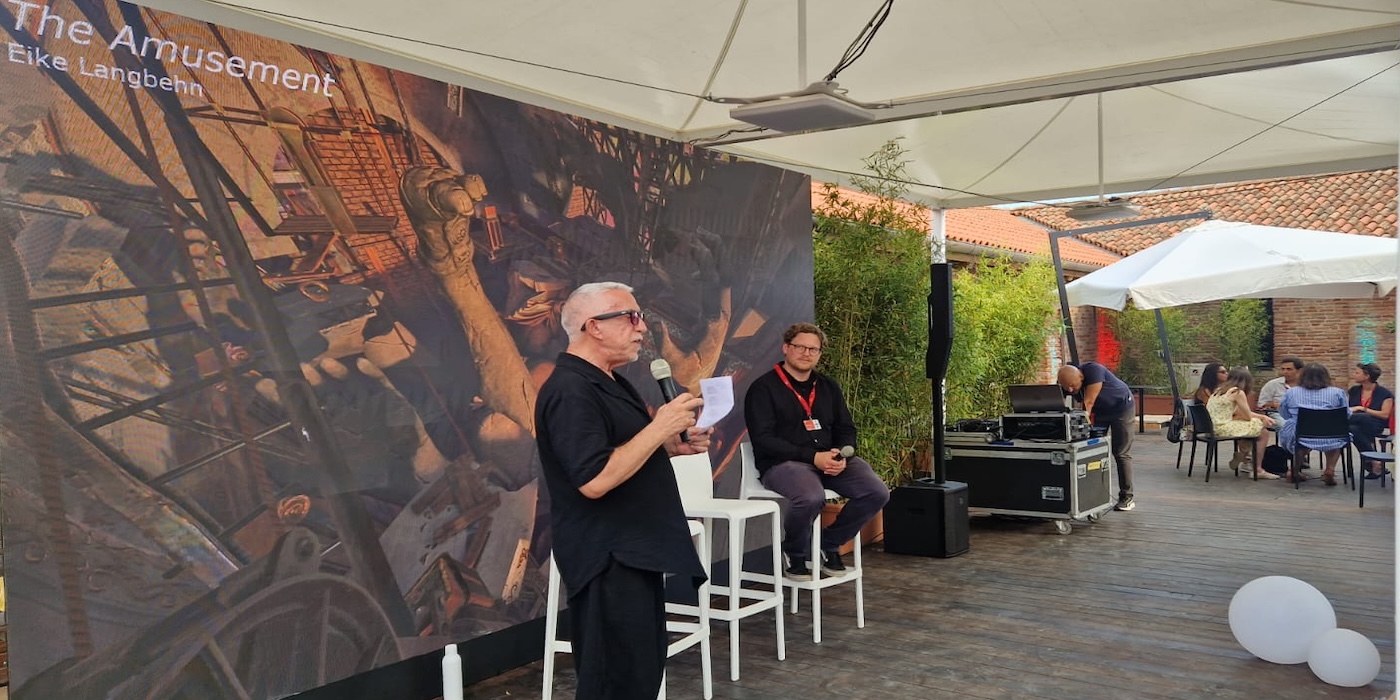
Today, September 3rd, the Venice Production Bridge opens on the Venice Immersive Island (Lazzaretto Vecchio Island) where Venice Immersive works are being showcased.
Venice Immersive is the Venice Film Festival and VPB flagship initiative dedicated to immersive works, turns 10 this year, while the it’s market, the Venice Gap Financing Market Immersive, turns 5. We talk to Michel Reilhac, curator, together with Liz Rosenthal of the Venice Immersive Selection and also of the VFGM Immersive selection.
The evolution of Venice Immersive
Venice Immersive has been a pioneering space since its inception in 2016. Michel Reilhac explains that its development parallels the rapid growth of immersive arts over the past decade. He highlights how the selection process has become increasingly sophisticated, with projects ranging from small independent studios to major organizations like Disney and Google. The focus has shifted from simple virtual experiences to complex, multi-user installations that can accommodate larger audiences and more intricate storytelling. This evolution reflects a broader trend in the industry, where immersive projects are becoming more ambitious in scale and technological complexity, pushing the boundaries of traditional cinema.
The social dimension of immersive experiences
A major theme in the interview is the social potential of Venice Immersive and related platforms. Michel Reilhac emphasizes how immersive experiences are increasingly collaborative and community-oriented. He mentions examples such as VR Chat, where thousands of users gather as avatars to socialize, play, and create together. These platforms allow people from all over the world to connect in a virtual space, fostering interactions that resemble real-life socializing. Michel believes that the future of immersive arts lies in shared experiences, which can be either virtual or physical, as seen in projects that gather groups of people in specific locations to witness collective storytelling or art exhibitions like “Bowie: Unseen | Unheard”, an immersive audio-visual experience that reimagines the photographic archive of legendary music photographer Denis O’Regan, featuring more than 800 iconic, rare and previously unseen images spanning two decades of David Bowie’s extraordinary career.
From collective to intimate experiences
Michel Reilhac also discusses how immersive arts are impacting cultural storytelling and emotional engagement. He notes that some experiences are designed to be intimate and personal, such as the virtual reality piece created by a woman singer from Poland who used VR to document her life and impending death (“Being In You”). Or the documentary about Palestine, “Raj’in (We Shall Return” tdocuments Israel’s ethnic cleansing of Palestinians in the West Bank through the stories of over 11 Palestinian communities facing forcible transfer, using a visceral blend of 360° cinematography and raw phone and handycam footage.
The link between the Venice market and festival shows how projects can progress from development (Biennale College Immersive) to financing (Venice Gap Financing Immersive) to final exhibition (Venice Immersive), creating a complete ecosystem that nurtures innovation in immersive cinema.