

Settimana Internazionale della Critica 2026: il programma completo della 41ª edizione
Sette esordi, quattro continenti e un cinema inteso come spazio di resistenza: la SIC 2026 presenta il programma completo della sua 41ª edizione.
Listeners:
Top listeners:
 play_arrow
ENGLISH Channel 01 If English is your language, or a language you understand, THIS IS YOUR CHANNEL !
 play_arrow
ITALIAN Channel 02 Se l’italiano è la tua lingua, o una lingua che conosci, QUESTO È IL TUO CANALE!
 play_arrow
EXTRA Channel 03 FRED Film Radio channel used to broadcast press conferences, seminars, workshops, master classes, etc.
 play_arrow
GERMAN Channel 04 Wenn Ihre Sprache Deutsch ist, oder Sie diese Sprache verstehen, dann ist das IHR KANAL !
 play_arrow
POLISH Channel 05
 play_arrow
SPANISH Channel 06 Si tu idioma es el español, o es un idioma que conoces, ¡ESTE ES TU CANAL!
 play_arrow
FRENCH Channel 07 Si votre langue maternelle est le français, ou si vous le comprenez, VOICI VOTRE CHAINE !
 play_arrow
PORTUGUESE Channel 08
 play_arrow
ROMANIAN Channel 09 Dacă vorbiţi sau înţelegeţi limba română, ACESTA ESTE CANALUL DUMNEAVOASTRĂ!
 play_arrow
SLOVENIAN Channel 10
 play_arrow
ENTERTAINMENT Channel 11 FRED Film Radio Channel used to broadcast music and live shows from Film Festivals.
 play_arrow
BULGARIAN Channel 16 Ако българският е вашият роден език, или го разбирате, ТОВА Е ВАШИЯТ КАНАЛ !
 play_arrow
CROATIAN Channel 17 Ako je hrvatski tvoj jezik, ili ga jednostavno razumiješ, OVO JE TVOJ KANAL!
 play_arrow
LATVIAN Channel 18
 play_arrow
DANISH Channel 19
 play_arrow
HUNGARIAN Channel 20
 play_arrow
DUTCH Channel 21
 play_arrow
GREEK Channel 22
 play_arrow
CZECH Channel 23
 play_arrow
LITHUANIAN Channel 24
 play_arrow
SLOVAK Channel 25
 play_arrow
ICELANDIC Channel 26 Ef þú talar, eða skilur íslensku, er ÞETTA RÁSIN ÞÍN !
 play_arrow
INDUSTRY Channel 27 FRED Film Radio channel completely dedicated to industry professionals.
 play_arrow
EDUCATION Channel 28 FRED Film Radio channel completely dedicated to film literacy.
 play_arrow
SARDU Channel 29 Si su sardu est sa limba tua, custu est su canale chi ti deghet!
 play_arrow
“Conversation with” at the 20th Marrakech IFF, interview with actor Willem Dafoe Bénédicte Prot
The Venice International Film Critics’ Week has unveiled the programme of its 41st edition. It will take place on the Venice Lido from 2 to 12 September 2026, during the 83rd Venice International Film Festival.
The Italian National Union of Film Critics organises the independent section. It will present seven debut features in competition and two special events out of competition. Every title will screen as a world premiere.
General Delegate and Artistic Director Beatrice Fiorentino curated the programme. The selection committee also includes Matteo Berardini, Marianna Cappi, Francesco Grieco and Marco Romagna.
“Imagining the future. Resisting the present” defines this year’s direction. The films approach cinema as an act of responsibility and formal research. They also examine a world shaped by political, social and technological change.
Speaking with Chiara Nicoletti for FRED Film Radio, Fiorentino explained the selection principle. “We cannot shut ourselves inside a bubble and pretend not to see what is happening outside.”
For Fiorentino, festival programming is never neutral. Images reflect the world in which they are produced. Therefore, choosing which stories to show also means taking a position.
“When you programme a festival, you encounter stories and images that mirror the world in which we live,” she said. “Choosing which stories should be shown becomes an act of responsibility.”
However, the final line-up also emerged through a fluid process. “You make programmes with the stories you encounter. The selection process is very dynamic,” Fiorentino noted. “At a certain point, the programme partly shapes itself.”
The political character of the selection concerns both content and form. “Every film is political,” she said. “We care deeply about language and formal research. We listened to political stories and tried to make the selection politically.”
The programme also includes several independent productions. Some were made with limited resources. Nevertheless, Fiorentino stressed their artistic precision and strong awareness of the medium.
Two films represent Colombia. The End of Times, directed by Bibiana Rojas Gómez and Juan David Cárdenas, combines family archives, colonial memory and artificial intelligence.
The film questions the need to generate new images in an already saturated world. “There is a declaration of image economy at the basis of the project,” Fiorentino explained. “Does it still make sense to shoot new images, or can cinema use those that already exist?”
A woman searches for the origins of her mother’s sadness. Gradually, that private investigation reveals the trauma of an entire country. “While looking for the reasons behind one woman’s suffering, the film discovers the roots of a people’s malaise.”
The second Colombian title is Meteorite by Sebastián Múnera. It follows two women through a landscape marked by violence. A theme park built on the ruins of Escobar’s empire stands beside a regional prison.
Tunisia enters the competition with The H@llow Man by Kamel Laaridhi. The dystopian drama is set in 2059. In its world, a biochip controls memories and suppresses emotions.
“It is a form of para-science fiction,” Fiorentino said. “The future becomes a pretext for bringing present urgencies back into focus.” In the film, poetry becomes a defence against technological control.
Brazilian directors Victor Di Marco and Márcio Picoli present London. The queer drama explores disability, sexuality and self-determination. It also rejects reducing identity to a clinical diagnosis.
Meanwhile, Our Share of Sand by Shalini Adnani examines inequality and environmental exploitation. The India, United Kingdom and Greece co-production begins as a family drama. It then exposes a system shaped by silence, profit and sand extraction.
Italy competes with Before the War by Tommaso Usberti. The film is co-produced with France and set in the Po Valley.
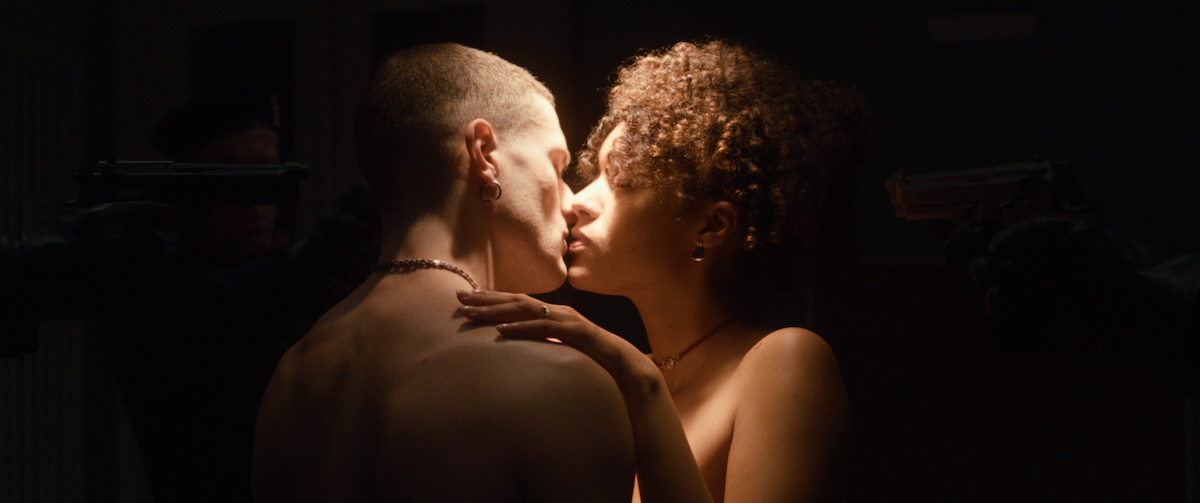
Its protagonist grew up in a racist and misogynistic environment. He must confront a model of masculinity based on violence and emotional repression.
Fiorentino described it as “a film that feels both contemporary and ancient.” She also noted “a Pasolinian tragedy of bodies” and landscapes that recall the early Bernardo Bertolucci.
Zoom In, Zoom Out by Dong Jie represent China. The urban mystery combines online gaming, digital identity and alienation.
Fiorentino called it “a manifesto film for Generation Z.” She also described it as “an updated Blow-Up and L’Avventura for the age of online gaming.”
The section will open with Giaffa the Great by Marco Santi. The cast includes Edoardo Pesce, Carlotta Gamba, Barbara Chichiarelli and Roberto Zibetti.
The protagonist is a socially invisible man. He is willing to alter his identity to be recognised.
According to Fiorentino, the film reflects “a completely schizophrenic society in which all points of reference have collapsed.” She added, “Being seen and finding a role in the system becomes more important than finding oneself.”
The closing film is Rider by Roan Johnson and Davide Pavanello. The rap musical features Levante, Rosa Chemical and Margherita Vicario.
“It was immediately striking,” Fiorentino said. “Even the spoken sections are in verse.” She compared its energy to an updated West Side Story.
The film addresses precarious labour, generational conflict and class divisions. “There is still a class conflict that nobody discusses anymore,” she said. “Yet it is far from resolved.”
The programme also includes the 11th edition of SIC@SIC, developed with Cinecittà. The Critics’ House will also return in a new location.
Competition titles will be eligible for the IWONDERFULL Grand Prize, the Audience Award and the Luciano Sovena Award. They will also compete for the Mario Serandrei Award and the Verona Film Club Award.
Eligible debuts will enter the race for the Lion of the Future, the Venice Award for a Debut Film.
Sette esordi, quattro continenti e un cinema inteso come spazio di resistenza: la SIC 2026 presenta il programma completo della sua 41ª edizione.
Discover all the winners of Critics' Week 2025! Oscar Hudson's STRAIGHT CIRCLE wins the IWONDERFULL Grand Prize for Best Film.
Eva Sangiorgi, director of the Viennale 2026, on a city festival with over 100 features, no competition and a Robert Aldrich retrospective.
Ruth Beckermann on Wax & Gold, her documentary on Ethiopia seen through a hotel in Addis Ababa, at the Rome Film Fest 2026.
A dark fairy tale about growing up, belonging and the fear of being replaced. Bàrbara Farré and Diego Betancor discuss the personal origins of Mala Bèstia, its unsettling vision of adolescence and the decision to make a debut feature without …
Character designer Thibault Leclercq talks about Wildwood and its stop-motion puppets, at the 24th edition of Alice nella Città.